


Great writing like this is made possible by paid subscribers to A Public Witness. Please consider upgrading today, as your annual $50 subscription sustains this ministry. We literally can’t do this without you.
One of the best compliments you can give a horror film is to describe it as “chilling.” That’s also the most accurate word to describe Bradley Onishi’s new book, American Caesar: How Theocrats and Tech Lords are Turning America into a Monarchy, but this horrifying tale doesn’t end when the credits roll and the lights turn on. It’s a scary story that is all too real.
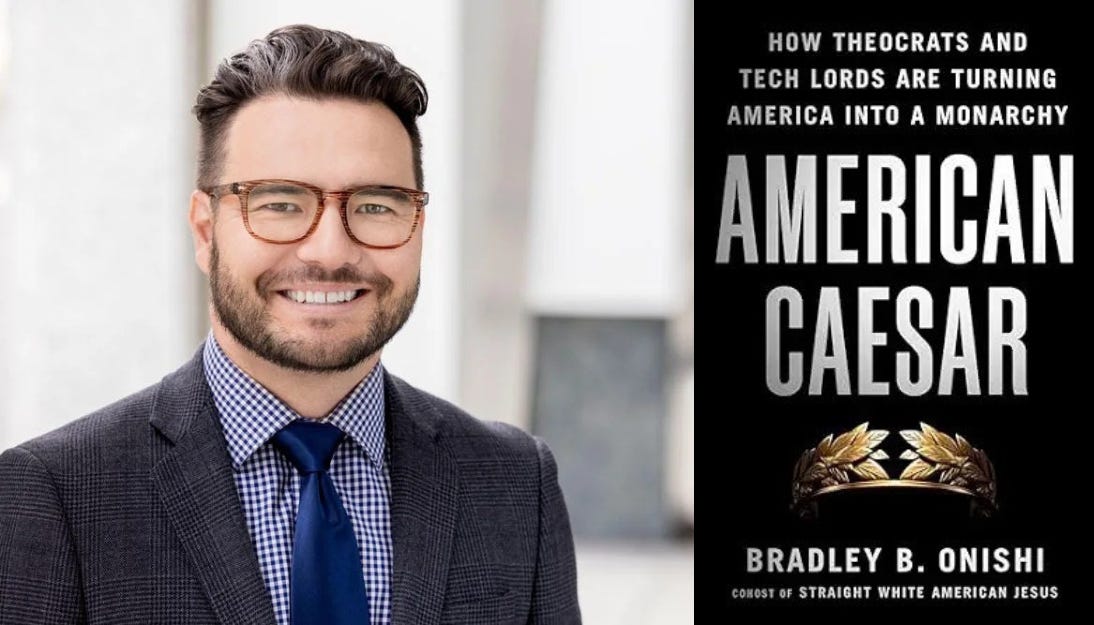
The plot is simple. The consequences are profound. We are experiencing the rise of a new class of ruling elites who seek to use religion and technology to replace democracy with authoritarian rule. It sounds extreme, even implausible. And yet, Onishi documents the ideas, the speeches, the organizing activities, and those in positions of power who are advancing that agenda.
The alarm likely hasn’t been heard in most American churches. Pastors preach sermons unpacking a gospel story or urging their parishioners to be a little nicer, a bit more other-minded, to slightly increase their focus on the wider community. Church members appreciate the nice sentiments and work to plan the next congregational luncheon. They scold the pastor for any sermon that gets “too political.” They continue to operate within the liberal project, where the church respects all choices and only tells people what to do in the most gentle of ways.
If Onishi is correct, then everyone is fiddling while Rome burns. Democracy’s opponents are extending a radical invitation: the only way to protect true Christianity, ensure the safety of society, and reap the full benefits of technology is to end democracy. Freedom is dangerous because everyone gets a say, and some of those people don’t want what these reactionary Christian leaders and tech utopians believe society needs.
These postliberals believe American democracy has run its course and the real danger is continuing the experiment. The liberties it protects allow people to make choices that reject traditional religious worldviews and practices. Its individualism eliminates the possibility for shared meanings and values.
Some of the figures Onishi builds his argument around are well known. Peter Thiel’s apocalyptic visions that view societal efforts to rein in technology’s unbridled march as the work of the Antichrist are well documented. For Thiel, Elon Musk, and others, Onishi highlights how technology has become an idol that is described in biblical language and conceived as humanity’s path to redemption.
Others are becoming more familiar as they have increased their influence and power. For example, the far-right pastor Doug Wilson has argued that a political leader “has the responsibility, as a public figure, in the discharge of his office, to believe in Jesus, Lord of heaven and earth.” That idea is fundamentally at odds with the U.S. Constitution’s explicit statement that “no religious Test shall ever be required as a Qualification to any Office or public Trust under the United States.”
A few decades ago, Doug Wilson’s views would have been dismissed as retrograde. Now, a man who has stated that “the great secular experiment that is America appears to have gone out behind the barn and shot itself,” is planting churches in Washington, D.C., preaching in the Pentagon, and exercising moral influence over Trump administration officials.

It can be difficult to identify the overlapping interests between Christian reactionaries longing to return the United States to a mythical past and Silicon Valley titans seeking to remove any and all obstacles impeding their understanding of progress.
As the saying goes, “the enemy of my enemy is my friend.” When democracy’s restraints are seen as the problem, then all those working to undermine it are united in common cause. The battle over its replacement can be waged after its collapse.
American Caesar forces the reader to consider the dangers before us, but it is not a book devoid of hope. The good news is that this fight is in its early rounds and there’s ample opportunity to renew the best of the democratic tradition that we have come to take for granted.
“We have forgotten how to speak of democracy not as permission to ‘do you,’ but as a shared project — one in which freedom is secured together by resisting those who would make us subservient,” Onishi writes. “Democracy becomes sacred when it is understood as the fragile structure that reveres truth as the only royalty, sees leaders as removable, and promises to keep violence in check.”
Go read American Caesar. It will scare the hell out of you. Then, get to work protecting a common life where Christian faith promotes democracy rather than becoming a tool for its demise.
As a public witness,
Beau Underwood