


I’ve often mentioned Patrick Henry in presentations about Christian Nationalism and religious liberty. But a recent conference at Colonial Williamsburg marked the first time I’ve shared the stage with him — or, at least with a Henry impersonator.
Although most famous for his “give me liberty or give me death” speech, Henry was a significant figure well beyond those seven words. The first post-colonial governor of Virginia, he was also an influential opponent of the U.S. Constitution. And he often found himself sparring with Thomas Jefferson and James Madison, including on church-state issues. That’s why I mention him.
Madison wrote his famous document “Memorial and Remonstrance against Religious Assessments” to push for religious freedom and against the establishment of religion as a direct response to Henry introducing a Virginia bill in 1784 to create a tax with the proceeds to be given to churches to support Christian ministers. Madison managed not only to defeat Henry’s proposal but also to instead get passed the Virginia Statute for Religious Freedom that Jefferson had written several years earlier. That act officially disestablished the Church of England (or the Episcopal Church) in Virginia, served as a model for the First Amendment to the U.S. Constitution, and was one of three accomplishments Jefferson put on his tombstone (along with the Declaration of Independence and the University of Virginia).
Henry is a key example that not all of the founders agreed with the idea of separating church and state, but Madison and Jefferson mostly won the debates as they created a new experiment in nonsectarian governance. So it was interesting to find myself on the program after Henry. But that’s the kind of thing that happens at Colonial Williamsburg, where the past and present meld together.
As a way of celebrating and thinking about the 250th anniversary of the United States, the Southern Union Conference of Seventh-day Adventists held an event focused on celebrating religious liberty. In addition to experts on the historic advocacy by Adventists for religious liberty, the week included non-Adventists like Randall Balmer, Steve Green, and myself. And since we were gathered at a place where you can walk down the street and step back into 1776 while people demonstrate various trades, crafts, and other roles while in colonial garb and character, the conference also included remarks from longtime impersonators of Henry, Jefferson, and Rev. Gowan Pamphlet (an enslaved preacher who founded a Black Baptist church in Williamsburg in the 1770s and became the first ordained Black preacher in the colonies).

The impersonators, who have studied and played their roles for years, brought a unique tone to the conference. Pamphlet is portrayed by a real Baptist pastor. I even enjoyed Henry, though I still disagree with him on church-state issues. As Henry took funny potshots at Baptists (since they were outspoken advocates for church-state separation and therefore often sided with his political opponents, Madison and Jefferson), others in the room would smile and look at me as the only Baptist in the room. So I decided I was not throwing away my shot. During the Q&A time, I introduced myself as one of those Baptists who think Madison and Jefferson were right by opposing his church tax bill and I asked him to explain how his system would work for churches that refused out of principle to accept the tax revenue. Later, I gave my presentation and emphasized why Henry’s proposal was problematic. I don’t think I changed old Henry’s mind, but that’s okay because I know Madison and Jefferson won the debate anyway!
Beyond interacting with Henry and the others — and wandering around to visit the old print shop, watch the rifle demonstration, and take in the fifes and drums march — this issue of A Public Witness takes you inside the conference to celebrate America’s heritage of religious liberty, with a special Adventist flavor.

Our Best Idea and Greatest Gift
Randall Balmer, author of America’s Best Idea: The Separation of Church and State, warned about the dangers of Christian Nationalists who want to undo church-state separation. To refute the claims by Christian Nationalists, Balmer suggested three main areas: theological, historical, and practical. As an Episcopal priest, historian of American religion, and a professor at Dartmouth College, Balmer offered some examples for each of those three tracks.
“Let’s start with theological,” he said. “John 18:36 — Jesus said, ‘My kingdom is not of this world.’ Let’s go home! What more needs to be said? ‘My kingdom is not of this world.’ That’s pretty good.”
Rather than going home, Balmer offered a few more thoughts on the theological problems with Christian Nationalism. He also pointed to Mark 12:17 and John 6:15. The former features Jesus using a coin to contrast “the realm of Caesar and the realm of God.” The latter occurs between the stories of Jesus feeding the 5,000 and Jesus walking on water. Balmer argued this easily overlooked verse between two famous stories shows Jesus’s attitude to taking political power: “When Jesus therefore perceived that they [the crowd he had just fed] would come and take him by force to make him a king, he departed again into a mountain himself alone.”
“It doesn’t sound like somebody running for office,” Balmer remarked.
Dealing with historical arguments, Balmer pointed out some misrepresentations and false claims popularized by pseudo-historian David Barton. Like claiming nearly all of the founders were devout Christians. Balmer instead traced the growth of the idea of church-state separation from Roger Williams, the founder of Rhode Island and a cofounder of the first Baptist church in the Americas. The ideas of Williams created the foundation for the new nation, especially the First Amendment.
“The First Amendment, first part of it is 16 words: ‘Congress shall make no law respecting an establishment of religion or prohibiting the free exercise thereof.’ And I contend that that is America’s best idea. Ken Burns says national parks are America’s best idea. I respectfully disagree, even though I like Ken Burns and I admire his work,” Balmer said.
After walking through various statements by founders about church-state separation, Balmer lamented that Christian Nationalists today are “working through legislation and judicial rulings, trying to undermine the separation of church and state, particularly at the state level.” And this concerns him because, turning to the practical refutation of Christian Nationalism, Balmer argued the separation of church and state has been good for both.
“It works. It has worked remarkably well for over 200 years,” he said. “It has shielded the government from religious factionalism. It is also protected the integrity of religion. … Ridding the nation of separation of church and state is the worst thing that could happen to faith.”

Steven K. Green, a law professor and director of the Center for Religion, Law, and Democracy at Willamette University, similarly warned about efforts to undermine church-state separation. He noted that the U.S. Supreme Court in recent years has created a “judicial imbalance” when interpreting the religion clauses of the First Amendment.
“We’re going in a direction where the two religious clauses are kind of out of whack with each other, out of sync with each other,” he added.
With the court’s focus on the Free Exercise Clause over and against the No Establishment Clause, this concerns Green since he sees religious freedom as “one of the greatest gifts that the United States has given to the world.”
“We may take it for granted, but religious freedom is the exception worldwide rather than the norm,” he added before noting that two-thirds of the world’s population live in countries “where there is either active religious persecution or religious discrimination.”
Green, author of Separating Church and State: A History, offered a historical walk through how the idea of church-state separation developed among preachers, politicians, and judges. And he noted the growing attacks on the idea in recent years, especially in the realm of public education.
After picking apart some recent court decisions where the high court has been allowing more sectarian content and expression into public schools and some potential problems that could emerge from those rulings, Green previewed some likely big Supreme Court cases coming soon that could further chip away at church-state separation. One is St. Mary Catholic Parish v. Roy, where Catholic preschools in Colorado are demanding to receive state funding even if they do not follow the state’s nondiscrimination rules required to receive such funding. Another potential case could come from Virginia as a Liberty University student requested the high court reconsider whether states should be forced to fund ministerial studies. Another potential case he pointed to is whether the Supreme Court decides to rule on states forcing public schools to post a highly edited version of the Ten Commandments in classrooms.

‘A Heritage of Advocacy’
In addition to considering religious liberty and American history more broadly, the conference at Colonial Williamsburg also highlighted the historic witness of Seventh-day Adventists on the issue.
“We have a heritage of advocacy in this area,” explained Bettina Krause, editor of Liberty magazine and associate director of public affairs and religious liberty for the North American Division of Seventh-day Adventists.
Krause highlighted the history of persecution of Seventh-day Adventists to explain why they have long advocated for religious liberty and church-state separation. This especially occurred because of “state-level Sunday rest laws.” Looking through the archives of the Adventist magazine she edits, which go back to 1906, she told a couple of stories of Adventists who were persecuted because of their Sabbath beliefs.
Like a man who was doing work around his own house in 1931 and was then arrested by police after a neighbor called to report he was violating the law against working on Sunday. The Adventist man argued he was being targeted for his beliefs since on the way to jail they passed men clearing brush on the side of a highway and an amusement park that was open. The judge ordered the man to appear in court on his own Sabbath — Saturday — which he protested to no avail. Eventually, he paid a fine for violating the law. Krause told other stories of Adventist pastors being arrested, jailed, and even forced to work on a chain gang for violating Sunday rest laws.
As a result of such experiences, Krause said, Adventists have been a small group but have a history of “punching above our weight on issues of religious liberty.” And their historical experience, she added, demonstrates a truth from James Madison’s document on religious liberty that he wrote in response to Henry’s church tax proposal.
“One of my favorite quotes: ‘Who does not see that the same authority which can establish Christianity, in exclusion of all other religions, may establish with the same ease any particular sect of Christians in exclusion of all other sects?’ Here’s the thing: We, as Adventists, we do not need law degrees, we do not need to understand constitutional law to understand this principle. Because we have lived it. We have lived it through the many, many decades when there were state-level Sunday rest laws,” she said.
Krause emphasized it was important to recall these stories since some no longer appreciate why they should support church-state separation. She lamented that “our church is suffering a crisis of memory” by forgetting what can happen to religious minorities like themselves when the government starts enforcing sectarian beliefs like Sunday rest laws. As a result, she fears some Adventists are open to Christian Nationalism since they don’t realize they could once again be targeted. She noted, however, that Adventists in many other countries are still “suffering the consequences of being religious dissenters” and so haven’t forgotten why religious liberty for all matters.

Joe Reeves, editor of the Adventist publication InVerse and assistant director of the Sabbath School and Personal Ministries of the General Conference of Seventh-day Adventists, similarly highlighted their long tradition of advocating for church-state separation going back to the 19th century. He quoted from Ellen G. White, a co-founder of the Seventh-day Adventist Church, and other early Adventist leaders.
Like the other speakers, Reeves warned about Christian Nationalists today who are seeking to change the balance between church and state, and he lamented that many Christians are getting caught up in the theology of seeking a earthly king to establish Christianity by force of law. In contrast, he urged Adventists to support the religious liberty rights of everyone, including Muslims and others they may disagree with.
“If we only believe in religious liberty for ourselves and nobody else, what kind of religious liberty is that?” he added. “So that’s why we believe in religious liberty for everybody. Otherwise, it’s not religious liberty at all.”
And Reeves warned about Christian Nationalists promising to bring about the kingdom of God. As a rebuttal to that mentality, he recalled a warning from White, the early Adventist prophet, in 1898 about how what that brings is not the rule of Christ but the authoritarian rule of one sect.
“Today in the religious world there are multitudes who, as they believe, are working for the establishment of the kingdom of Christ as an earthly and temporal dominion. They desire to make our Lord the ruler of the kingdoms of this world, the ruler in its courts and camps, its legislative halls, its palaces, and market places,” she wrote. “They expect him to rule through legal enactments, enforced by human authority. Since Christ is not now here in person, they themselves will undertake to act in his stead, to execute the laws of his kingdom.”
As a public witness,
Brian Kaylor
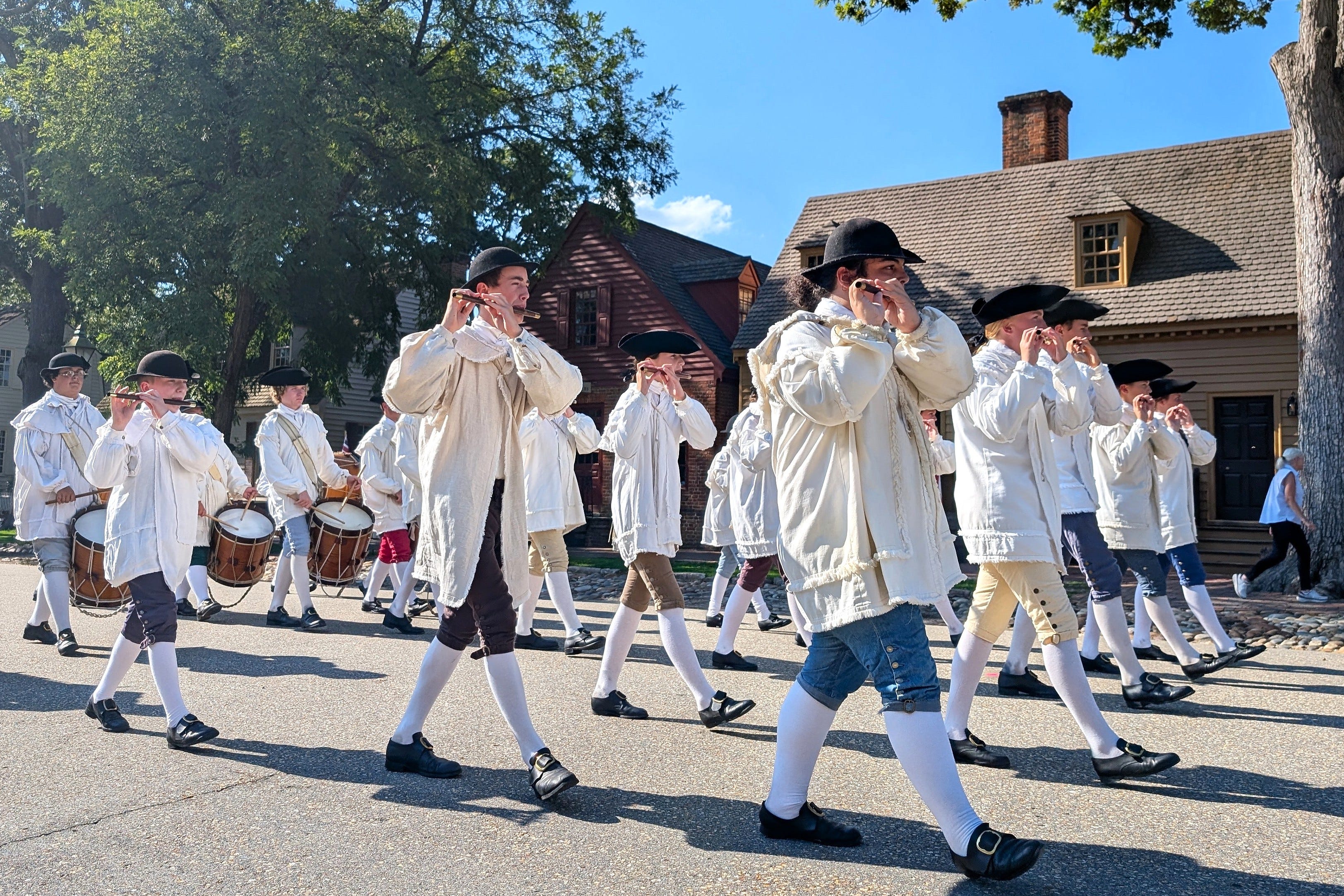
I was on a tour of Colonial Williamsburg in July this year. I missed seeing the fife and drum corps, but enjoyed all the reenactors of the various occupations (weavers, tailors, etc.) there. I agree that Christian Nationalism and religious liberty are incompatible.