



“It is worthwhile for one to be saved, so that others will benefit. … We are praying that all of God’s children can have a change in heart, and in this season of Lent, we would hope, pray, and trust that the governor will be able to show her strength and courage.”
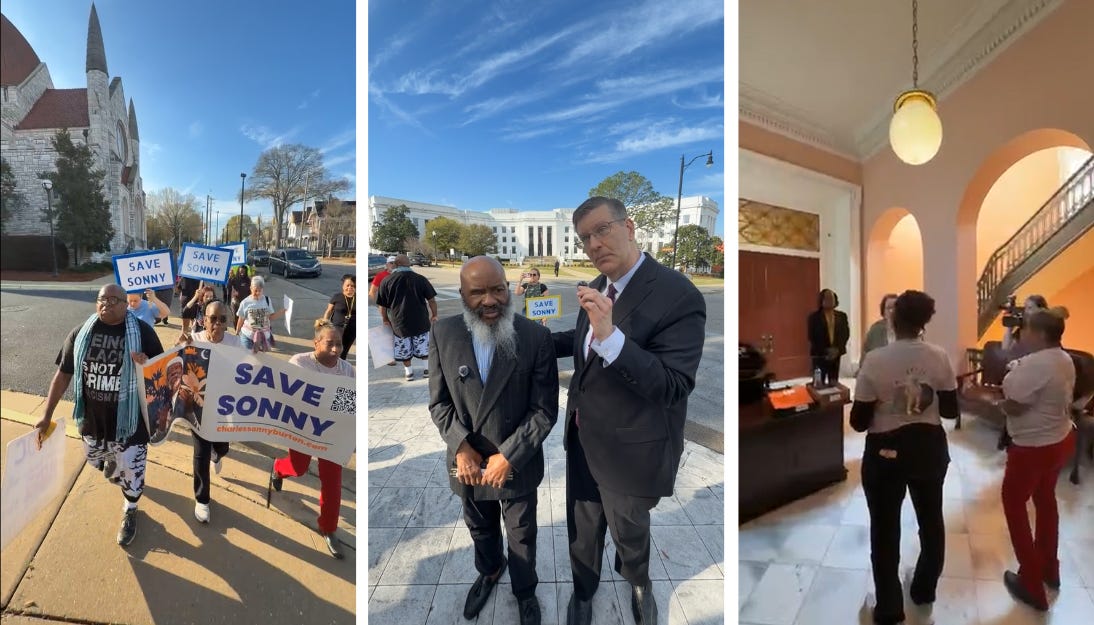
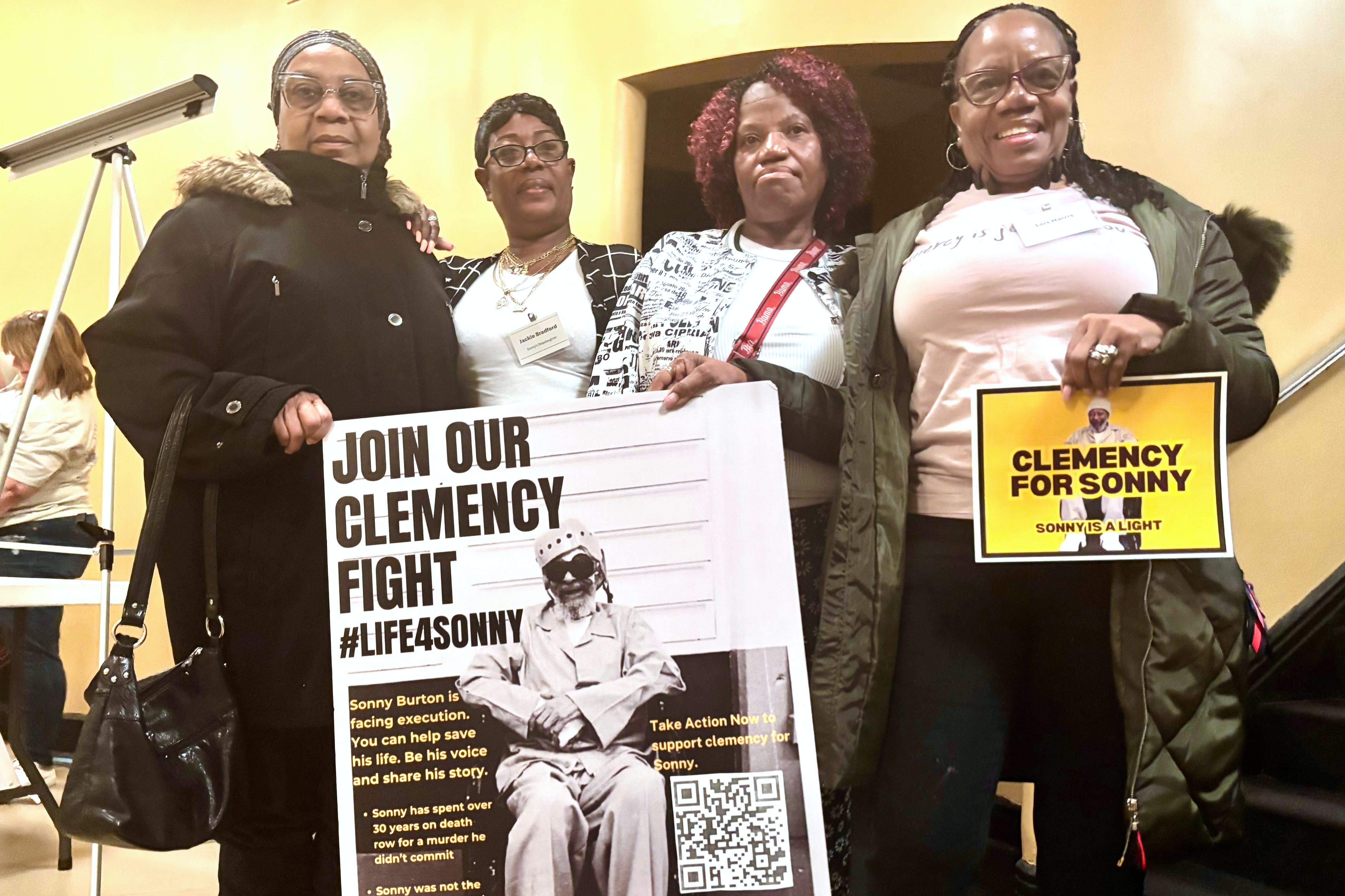
That’s what Rev. R.K. Smith said as he gathered with other faith leaders and community members on Monday (March 9) to deliver more than 60,000 petition signatures to Alabama Gov. Kay Ivey, urging her to commute the death sentence of Charles “Sonny” Burton.
In a surprise move, Ivey did so this morning, changing Burton’s sentence to life in prison without the possibility of parole. Her office had indicated as recently as Friday that she wasn’t planning to take that action.
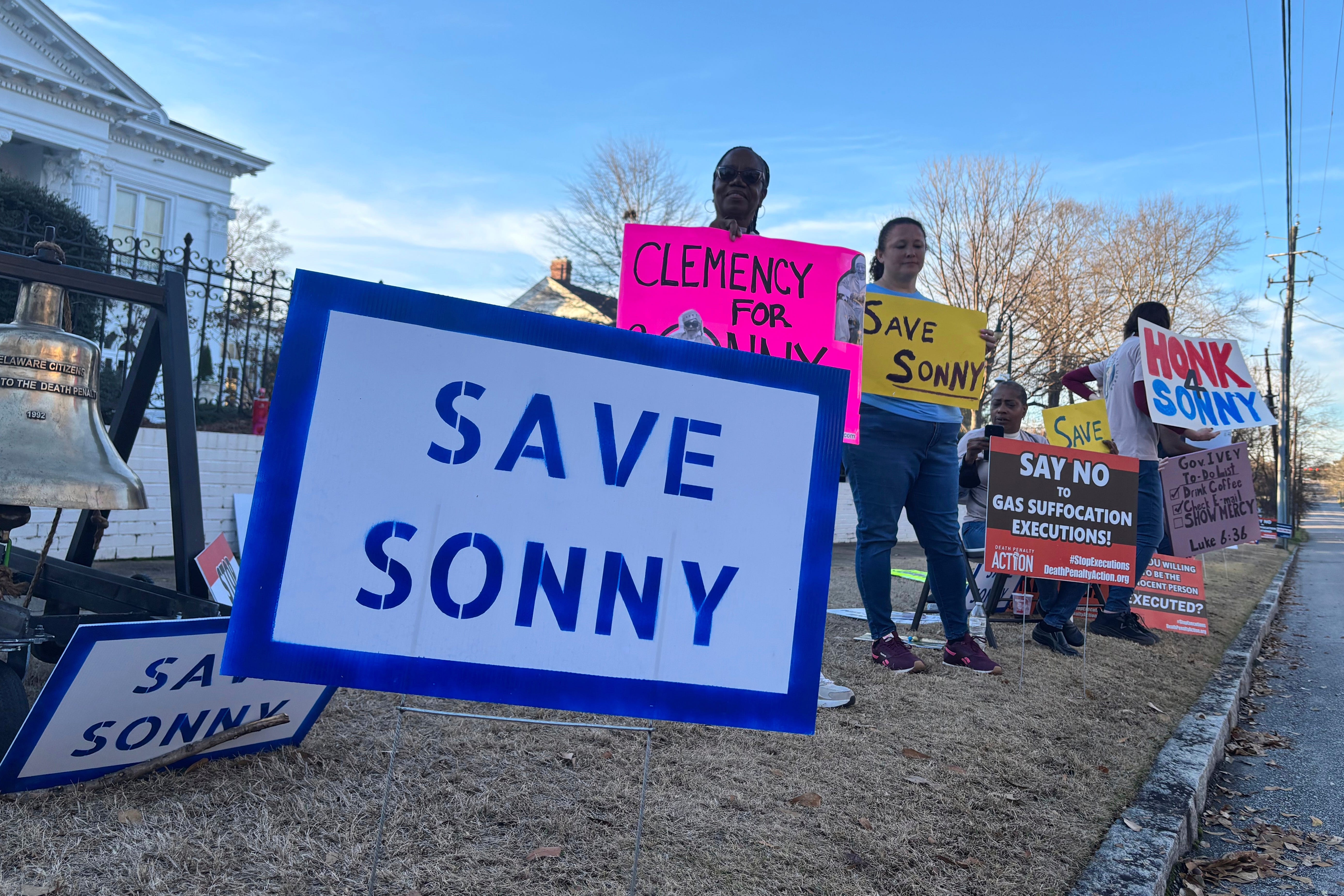
In opposition to Burton’s execution, which had been planned for March 12, the peaceful demonstration on Monday began outside the Governor’s Mansion in Montgomery and transitioned into a 1.5-mile march to the State Capitol.
Smith is the retired associate pastor of historic Dexter Avenue King Memorial Baptist Church, where the Montgomery bus boycott was planned during the Civil Rights Movement. Calling back to this history, he added, “When good people stand up, when good people call on the positive power of change, a change can happen.”
Burton is 75 years old and requires a wheelchair to get around because he can no longer walk. Moving at all results in a significant amount of pain due to a debilitating case of rheumatoid arthritis. The degenerative disease led the Department of Corrections to provide him with a padded helmet to limit his risk of falling before the execution. But what most bothers Burton, who is Muslim, is that he can no longer get on his knees to pray.
The religious protest on Monday concluded with a solemn prayer that Gov. Ivey would use her power to spare Burton’s life, followed by two of Burton’s daughters hand-delivering the petition to the governor’s office. The Republican governor has presided over the execution of 25 people during her nine years in office. She holds the record in Alabama for overseeing the most government-sanctioned killings since 1976, when the death penalty was reinstated nationally.
Alabama recently became the first state to put people to death using nitrogen suffocation. This came after a brief pause in executions in the state after three botched lethal injections took place. Despite state attorneys telling the public that the nitrogen method has been a success, reports from witnesses detail graphic and violent reactions to the gas. Nitrogen suffocation is generally avoided in euthanizing animals because it is known to cause panic and distress.
Due to the unique circumstances of Burton’s case, six of the eight living jurors from the trial supported commutation of his sentence to life without parole. And the victim’s daughter also urged Ivey to grant Burton clemency. So this issue of A Public Witness examines the extraordinary story about a man who has never been accused of killing anyone and the religious controversy about the timing of the now-canceled execution.
The Worst of the Worst?
During a 1991 robbery at a Talladega AutoZone, a man named Doug Battle was tragically shot and killed. Derrick DeBruce pulled the trigger, and when he did so he was acting alone. DeBruce was subsequently convicted of capital murder and sentenced to death, but this sentence was overturned due to inadequate representation at trial. After being resentenced to life in prison, he died while incarcerated in 2020.
So what does this have to do with Sonny Burton?
Burton was sentenced under Alabama’s felony murder statute. This means that in order to get a death penalty-eligible conviction, prosecutors only need to prove that a defendant was either an accomplice or tried to commit another crime during the relevant incident.
And Burton did indeed rob the AutoZone with four additional people. They brandished weapons and recklessly stole things. But he and the others involved all left the store and did not witness the subsequent fatal shooting. If Burton had been killed by the state, he would have been the only person of the six executed for Battle’s murder.
“You’re not wrong to think that sounds wrong,” Chris Geidner wrote at his newsletter Law Dork about this particular application of felony murder.
And according to the Death Penalty Information Center, at least 22 people have been executed using felony murder statutes despite having no direct involvement in the death of another person. Of that group, 60% were either Black or Hispanic.
Burton has publicly taken responsibility for his involvement in the crime: “All the years I have suffered with this, I suffered with the guilt, the pain, that the victim was feeling, that the victim’s family was feeling. … And I am so sorry. I want them to know that I am so sorry. And if I had the power to bring Mr. Battle back, I would do it.”
The U.S. Supreme Court rarely intervenes these days to stop an execution from taking place. For this reason, those advocating for Burton’s life focused on clemency from the governor, who has the power to turn a death sentence into life in prison and was likely Burton’s only hope.
“In choosing mercy for Mr. Burton, Gov. Ivey would not just be extending grace to a man who deserves it; she would be challenging a culture of indifference that has allowed Alabama’s prison system to grow too comfortable with its own inhumanity,” Elizabeth Vartkessian wrote in The New York Times before Ivey commuted Burton’s sentence.
The Sacred and the Profane
In addition to the issues around the crime and Burton’s sentencing, the scheduling of his execution for this week had sparked another concern. As a Muslim, this is currently the holiest time of the year for his faith.
“What really hurts me is the governor set my date during Ramadan,” Burton told AL.com last week. “I was sad and disappointed but I’d like to believe that she wasn’t aware that March 12 is during Ramadan. I’d like to think she didn’t know because she’s a Christian woman.”
Having converted to Islam while on death row — after growing up with a mom who was a Jehovah’s Witness and a dad who was a Baptist — Burton credits Islam with helping him deal with the anger that filled his life in the years leading up to the crime for which he was sentenced. He says it helped him forgive the man who killed his wife three years before Burton was arrested for the burglary.
Ramadan this year runs from Feb. 18 to March 19. Among the spiritual practices for Muslims during that time is fasting from dawn to dusk each day. The last 10 days are particularly important, and it’s during that time that Alabama had planned to execute Burton. His spiritual advisor, Imam Aswan Abdul-Addarr, compared killing a Muslim during Ramadan to killing a Christian at Christmas.
“There’s a lot of spiritual work being done during Ramadan from reading the Quran, to fasting to trying to do every possible good deed that we can,” Abdul-Addarr told AL.com. “It’s a combination of all those things that’s the main reason execution is held off because you want to give someone every opportunity to get themselves right in the eyes of God.”
Abdul-Addarr’s comparison to Christmas executions is apt. And while states have not executed people on Christmas Day, they have done so both during Advent leading up to Christmas and the “12 Days of Christmas” that actually start on Christmas Day and run until Epiphany. Like when Florida and Tennessee executed people during Advent last year, and when Missouri, Indiana, and Oklahoma did so in 2024. And Missouri executed someone on the 10th day of Christmas in 2023, which was the closest to Christmas Day in 40 years (until Oklahoma got even closer with one just six days before Christmas in 2024). Such executions have drawn criticism for the timing.
But while state killing sprees haven’t paused for any sacred days, Burton’s execution was set to occur amid a rise nationally in Islamophobia — and that was true even before the United States went to war with Iran. National and state politicians are pushing bills to demonize Islam, politicians who are Muslim are attacked because of their faith, and local communities have sought to block Muslims from exercising their First Amendment rights. Republican Rep. Andy Ogles even posted this week on Elon Musk’s X platform that “Muslims don’t belong in American society.”
Discrimination against Muslims has also occurred inside death chambers. In 2019, the U.S. Supreme Court justices voted 5-4 to overturn a stay of execution and allow Alabama to kill Domineque Ray. The Court of Appeals for the Eleventh Circuit had ruled Alabama couldn’t execute Ray because the state refused to allow a Muslim imam in the death chamber, even though the state allowed a Christian chaplain during executions.
Without explanation, the court’s majority ignored the disparity of treatment between Christians and Muslims and allowed the execution to proceed without a spiritual advisor. But Justice Elena Kagan blasted the “profoundly wrong” decision in a dissent signed by Justices Stephen Breyer, Ruth Bader Ginsburg, and Sonia Sotomayor.
“Ray has put forward a powerful claim that his religious rights will be violated at the moment the State puts him to death,” wrote Kagan, who called the treatment “religious discrimination.”
Kagan also pushed back against Alabama’s claims that Ray had not made his request in a timely fashion, given unclarity in state statutes and the fact that “the prison refused to give Ray a copy of its own practices and procedures.”
The execution of Ray without his imam quickly sparked criticism from religious leaders and commentators across the political spectrum. Apparently in response to the public outcry, when the justices faced a similar case the next month, they changed their decision.
On March 29, 2019, a 6-3 vote of the justices granted a stay of execution for Patrick Murphy as Texas refused to allow him a Buddhist spiritual advisor in the execution chamber, even though the state allowed Christian and Muslim chaplains. Chief Justice John Roberts and Justice Brett Kavanaugh changed their position to join the four more liberal justices.
“The Constitution prohibits such denominational discrimination,” Kavanaugh wrote.
In response to that ruling, Texas and Alabama decided that instead of allowing clergy of various traditions into the execution chamber, they would instead bar all spiritual advisors. That led to another lawsuit from Texas from John Ramierz, who wanted his Southern Baptist pastor to touch him and pray out loud during the execution. The justices ruled 8-1 in 2022 that states had to allow spiritual advisors inside the death chamber during an execution.
Despite that, Missouri in 2023 refused to allow a Muslim spiritual advisor to be with Leonard “Raheem” Taylor as the state killed Taylor. The state claimed Taylor hadn’t followed the polices, but then eventually admitted to us at the time there wasn’t actually a policy (even though the U.S. Supreme Court had specifically told states they should develop such policies about spiritual advisors in the chambers).
“There is definitely something wrong where spiritual advisors are allowed for those who are Christian but not who are Muslim,” Rod Chapel, president of the Missouri NAACP, said as he stood on the steps of the state Supreme Court building during a rally hosted by Missourians to Abolish the Death Penalty on the day of Taylor’s execution. “Here the law is taking away our very morality, our ability to pray even at the worst moment that you can imagine, when a state-sanctioned murder is occurring.”
And until this morning, Alabama was preparing to execute a Muslim during his faith’s holiest time of the year. Ivey did not address that issue in her commutation. She instead stopped the planned execution because of the fact that Burton had not actually killed anyone and wasn’t even present at the time of the murder.
News of the commutation came just before we were about to publish an earlier version of this piece. We initially wrote a pessimistic ending, not expecting Ivey to save Burton’s life. So we will instead give him the last word as he explained why he thought Ivey would do the right thing.
“I believe,” he told AL.com last week. “The governor is a Christian woman and her religion teaches that it’s not ‘an eye for an eye.’ I believe she will see this is a miscarriage of justice.”
As a public witness,
Brian Kaylor & Jeremy Fuzy