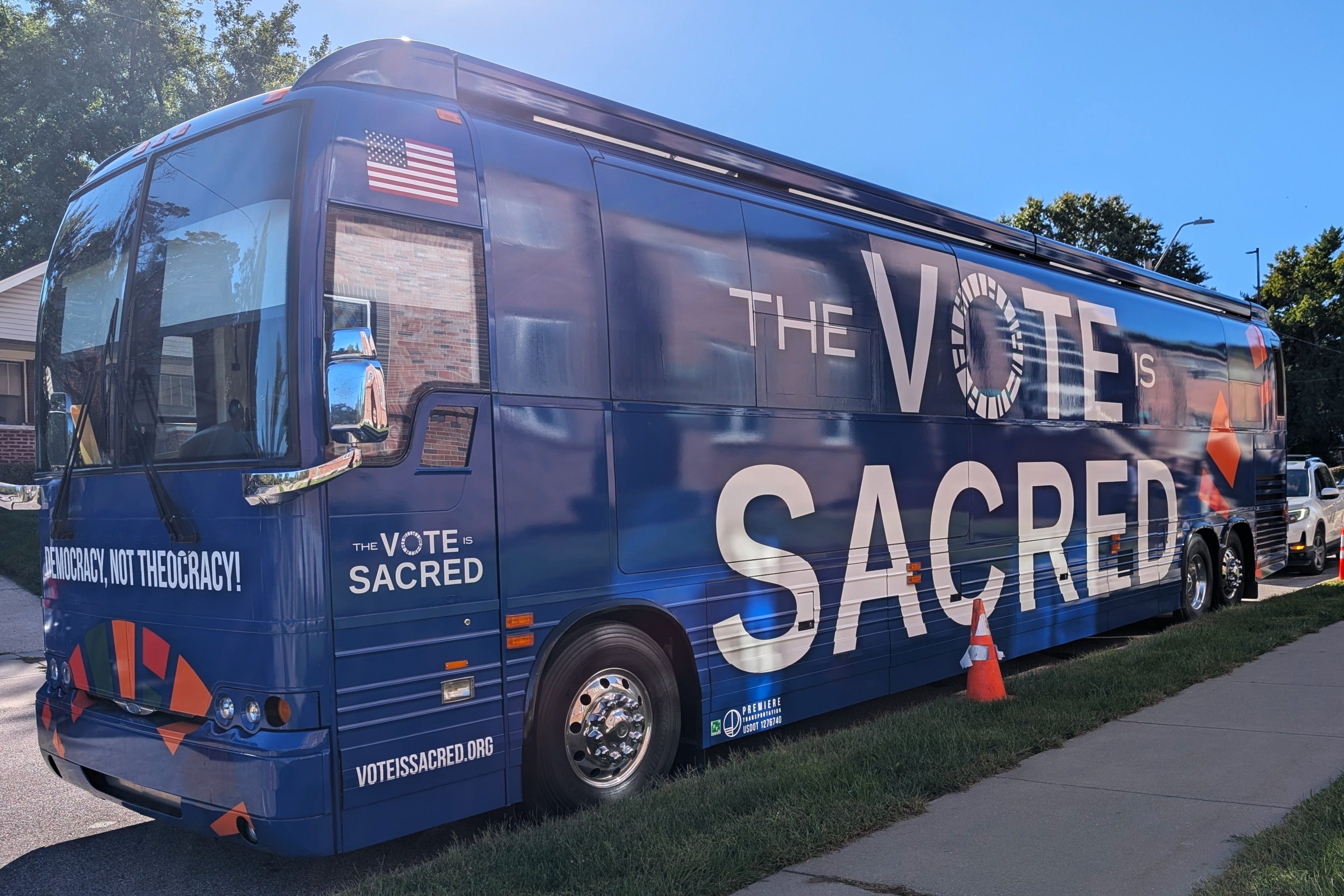
“We are here because human dignity matters. Truth matters. Community matters. Freedom matters. Democracy matters. And democracy only works when every voice has the power to be heard.”
Rev. Traci Blackmon, a United Church of Christ minister from St. Louis, fired up the crowd at St. James United Methodist Church in Kansas City on the other side of Missouri during the first stop of Interfaith Alliance’s national “The Vote Is Sacred Tour” on Monday (Oct. 5). With 30 stops in 18 states, the nonpartisan, interfaith bus tour is designed to get clergy involved in protecting voting rights and encouraging people to vote in the midterm elections.
Interfaith Alliance launched “The Vote Is Sacred Tour” in 2024, going that year to just six states. The tour’s name is drawn from a remark by the late civil rights activist and U.S. Rep. John Lewis: “Your vote is precious, almost sacred. It is the most powerful nonviolent tool we have to create a more perfect union.” This year’s expanded tour will wind through the upper Midwest before swinging through the Southeast and then the Southwest before ending with a post-election event in Colorado.
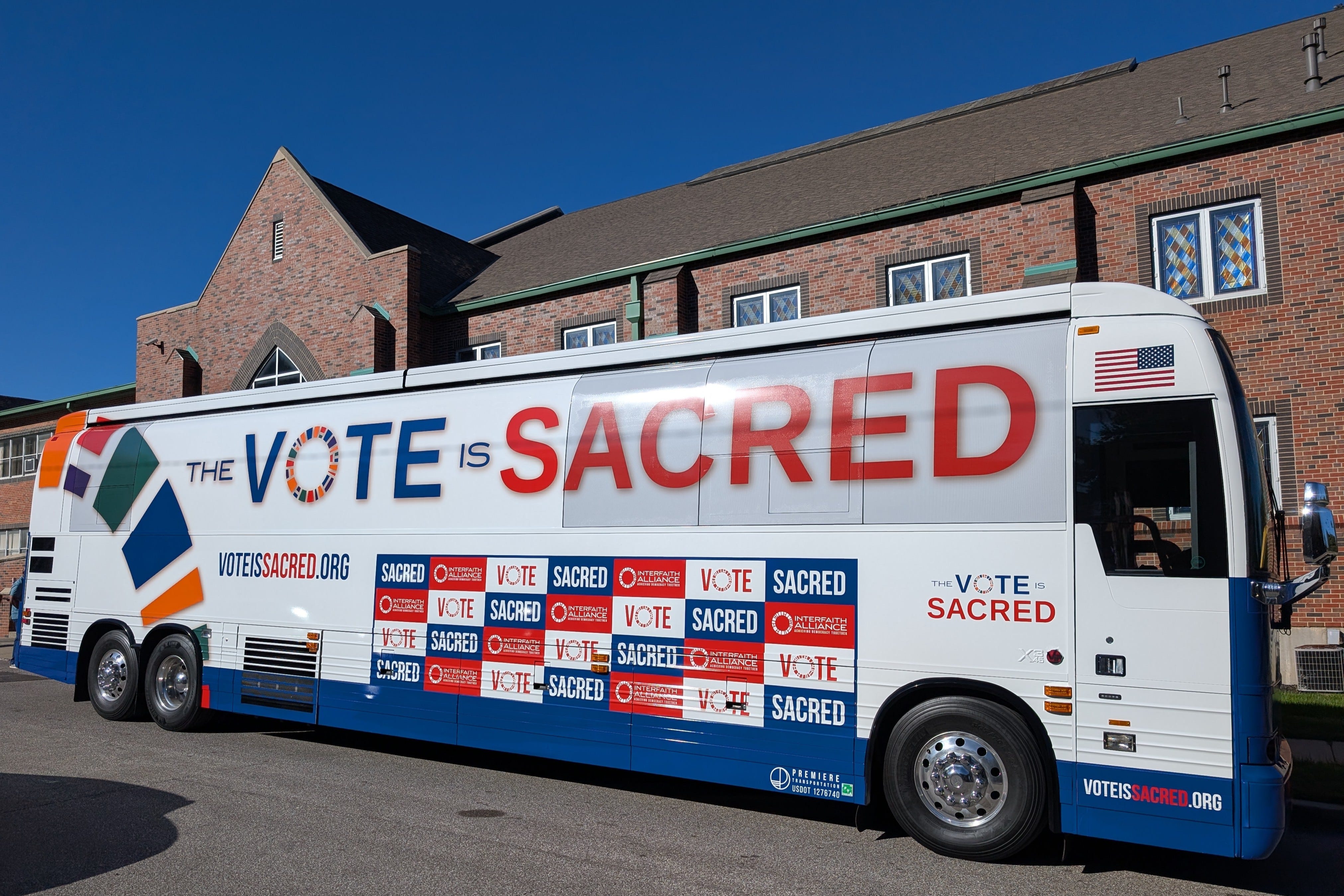
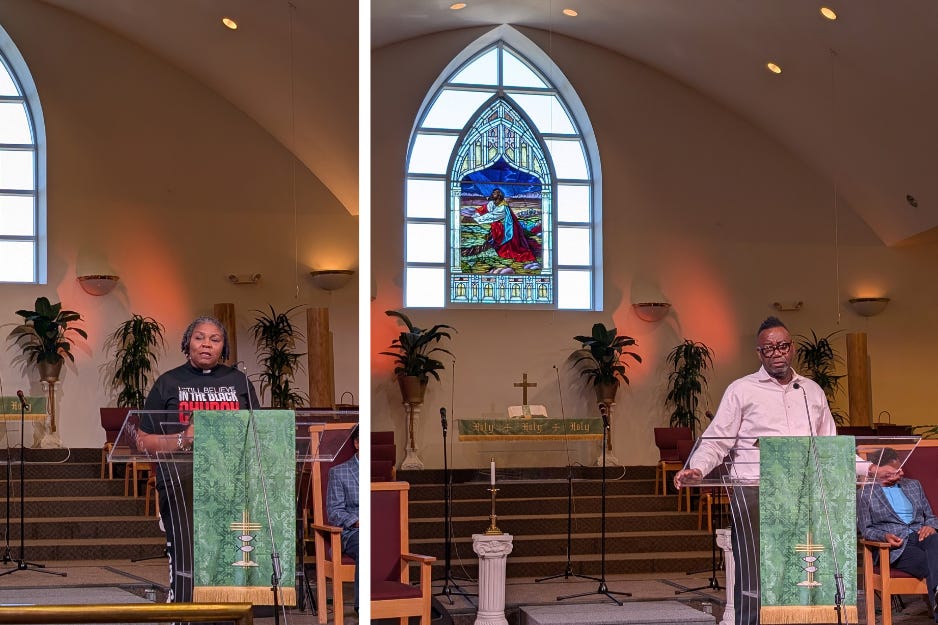
“Voting is not the whole of democracy, but democracy cannot be whole without the vote,” Blackmon declared at Monday’s event as she argued for protecting voting rights. “Democracy cannot remain strong if people stop participating. Representation cannot work if people decide their voices don’t matter. And the government of the people cannot function well without the voices of we the people.”
“Democracy is not a spectator sport. We cannot cheer for democracy from the sidelines. You cannot simply post about democracy online. You cannot merely preach about democracy. You can’t just complain about democracy. At some point, you have to participate in it,” she added. “Voting is not about worshiping government; it’s about accepting our responsibility for community. It’s about saying that my neighbor matters, my children matter, my elders matter, my community matters.”
With less than a month before the midterm elections, Blackmon and other speakers noted that the problem is not just voter apathy or confusion. This year has seen lawmakers and judges rolling back the rights and choices of voters, and the Trump administration is even threatening to send agents to voting places on Nov. 3. That’s why Interfaith Alliance is mobilizing clergy to help protect voting rights. So this issue of A Public Witness drives over to the opening stop of the 2026 “The Vote Is Sacred Tour” at a church that’s seen firsthand the efforts this year to distort elections and dilute the voting power of Black communities.
‘Voting Is an Act of Justice’
Rev. Thomas Bowen, the general secretary of the Progressive National Baptist Convention and Interfaith Alliance’s visiting senior fellow for faith and democracy, talked at Monday’s rally about the importance of continuing to push for voting rights and access for all people. As a leader in what was the denominational home of Rev. Martin Luther King Jr., Bowen stressed that he and other clergy members continue to push for voting rights and access because their ancestors prayed, organized, marched, bled, and even died for such rights.
“When we say ‘the vote is sacred,’ we’re not saying that any political party is sacred. We’re not saying that any candidate is sacred. We are saying that the right of the people to have a voice in determining their own future is sacred,” Bowen said.
“Democracy isn’t something that belongs to Washington,” he added. “It belongs to we the people.”
Bowen also argued that in a nonpartisan way, faith leaders should work to protect voting rights. He emphasized they were doing this as a multifaith group, not as an effort to “brand” the nation with “one particular belief.”
“Faith has something to say about human dignity. Faith has something to say about justice. Faith has something to say whether our neighbors are treated fairly and whether every eligible citizen participates in our democracy without intimidation or obstruction,” Bowen said.
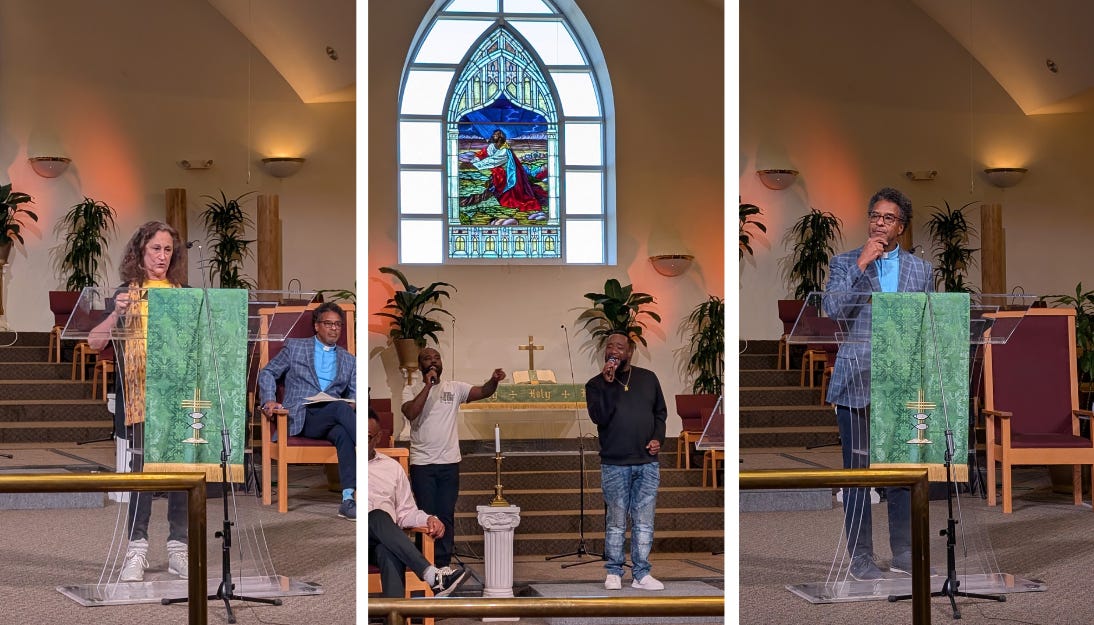
Rev. Rodney Williams, pastor of Swope Parkway United Christian Church in Kansas City, similarly insisted that “voting is an act of justice.” He argued that since voting “allows us to express our whole humanity,” it must be protected from “unjust, inhumane” politicians in the state and nation who seek to block the people from participating. He criticized efforts to stop people from voting or having a full voice in democracy as inspired by racism and “White Christian Nationalism, which is not Christian at all.”
“Without full access to the ballot, we become slaves to the rule of money. Without access to the ballot, we become slaves to manipulation and of extremists,” Williams added.
The host pastor for the rally, Rev. Emanuel Cleaver III, argued that this effort was part of what it means “to put our faith into action.” He argued clergy should act to protect members in their community since such rights are under attack.
“Today, we fight against modern forms of voter suppression. They fought it in the ‘60s and we’re still dealing with it today,” he explained. “When I think of the civil rights movement, I think of their desire for justice and equality and fairness. That’s why they used to sing, ‘Ain’t Gonna Let Nobody Turn Me Round.’ Dogs didn’t turn them around. Water hoses didn’t turn them around. Police brutality didn’t turn them around. The KKK didn’t turn them around. Public lynchings didn’t turn them around. Cross burnings didn’t turn them around. They just made up in their minds, ‘I ain’t gonna let nobody turn me around.’”
“And today, in 2026, we need some people of faith willing to stand and say, ‘I don’t care what they throw at me, I ain’t going to let nobody turn me around. Gerrymandering won’t turn me around. Politicians trying to overturn the will of the people won’t turn me around. Attacks on free speech won’t turn me around. Dismantling civil rights gains won’t turn me around. Changing polling locations won’t turn me around. Voter intimidation won’t turn me around. False information won’t turn me around,’” Cleaver III added. “We need people of faith here in Kansas City and across the state to stand together, to stand boldly and say, ‘I don’t care what they throw at me, my goal is justice, my goal is freedom, my goal is inclusion, and I ain’t gonna let nobody or nothing turn me around.’”
Celebrating a Win Against Gerrymandering
While this year has brought actions across the country by politicians and judges to limit the voting power of Black communities, that issue was particularly fresh for the clergy at the first stop of Interfaith Alliance’s bus tour. Rabbi Susan Talve of Central Reform Congregation in St. Louis joined other speakers in criticizing gerrymandering efforts in the Show-Me State.
“As we in Missouri have spoken, that we will not have our districts be gerrymandered by politicians,” she declared to applause. “We said to the country: Voters pick leaders; leaders do not get to pick their voters. Leaders do not get to weaponize religion and use faith to manipulate self-serving ends that do not protect the common good.”
The effort to slice up Kansas City along historic racial dividing lines was ultimately blocked last month after months of legal battles and political maneuvers that saw a unanimous state Supreme Court stop the redistricting effort and a unanimous U.S. Supreme Court rule — three times in one month — against the GOP. Had the redistricting effort not been blocked, Kansas City would’ve been split into three districts and outvoted in each by large swaths of rural voters. Not only would this have left the city without a representative who lives there, but it would likely have shifted one congressional seat to the Republican Party.
It’s an issue that those in the host congregation know well. Just outside the sanctuary, a portrait of a former longtime pastor hangs in the hallway. But he’s been in the news more recently as the target of the gerrymandering effort. U.S. Rep. Emanuel Cleaver II is also a United Methodist minister who served as senior pastor at St. James for 37 years before his son assumed that role.
While dozens of clergy from various denominations and faith traditions sat together at the front of the church during the rally — and held hands while singing — the elder Cleaver sat off to the back quietly watching. He did not speak and was not mentioned during the nonpartisan rally. He attended as a member of the clergy who’s concerned about voting rights and as someone who’s spent months fighting for representation for his community. But like him, many in the pews had been impacted by the electoral chaos as the political and judicial fight kept moving where and for whom people would vote.
“Your participation matters,” Traci Blackmon said the debates about gerrymandering and voting rights should remind us. “Where lines are drawn matters. Who has access matters. Who has registration that’s current matters. Whether you know where you vote matters. Whether you understand the rules matters. And whether you actually cast your vote matters.”
As a public witness,
Brian Kaylor