


On Tuesday (April 21), the Fifth Circuit Court of Appeals overturned previous rulings to say the state of Texas can force public schools to post a highly edited version of the Ten Commandments in public schools. The 9-8 ruling is particularly atrocious since the majority overturns a standing Supreme Court precedent on placing the Ten Commandments in schools. I’m not sure who they think died and made them the arbiters of religion, but I do know that nine people did not die to make them the Supreme Court.
Making the ruling even more galling, the majority opinion conscripted John Leland, a legendary colonial Baptist figure who fought for church-state separation, to justify their convoluted argument that the Texas law does not constitute the establishment of religion. The justices in the majority were only able to quote Leland by taking a couple of sentences out of context and by ignoring the clear words of a man who warned us that “the fondness of magistrates to foster Christianity has done it more harm than all the persecutions ever did.”
Making all of this even worse, the Texas law will now force public schools to post a gerrymandered version of the sacred text that doesn’t even match what’s found in any version of the Bible. As I previously documented in the first installment of our podcast series “A Trick of State” (which draws its name from Leland’s writings), the language required in the “Ten Commandments” laws passed over the last couple of years in Texas, Louisiana, and Arkansas is based on the Protestant KJV text in Exodus 20, but makes significant changes. It’s kind of like quoting the Pulp Fiction version of Ezekiel 25:17; it might be inspired by the Bible, but it’s not actually the biblical text. That means that if you literally ripped the Ten Commandments out of your Bible and taped them to a classroom wall in these states, the actual words from the Bible would be in violation of the law!
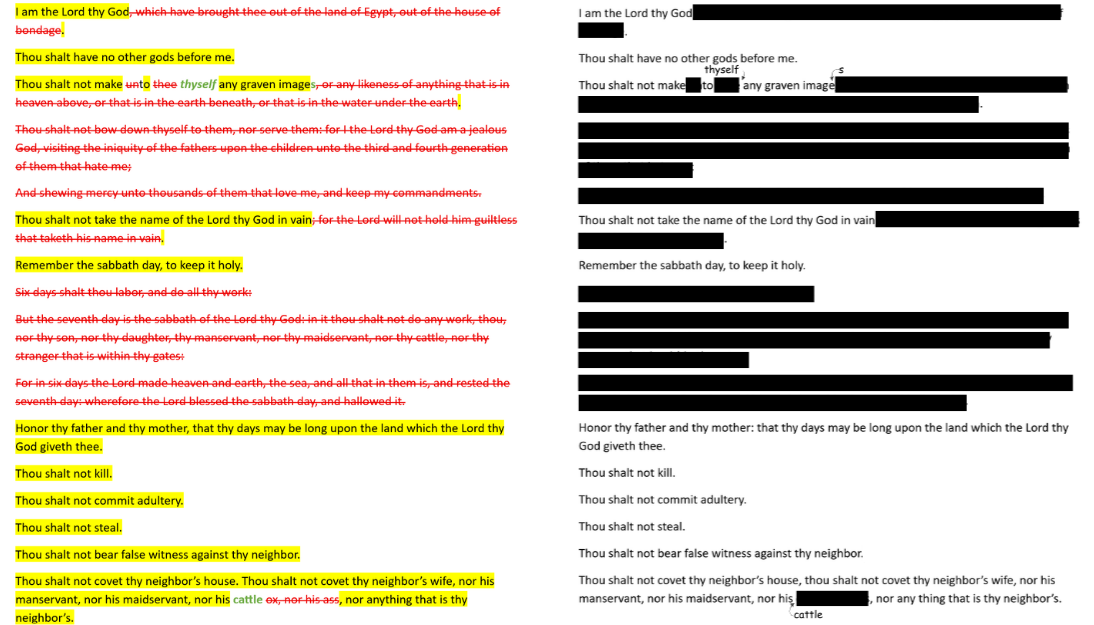
States like Texas aren’t just establishing religion; they’re establishing their own state-approved text and disallowing any other version that’s held sacred by believers. It’s a clear violation of First Amendment rights. That’s why the organizations representing the multifaith group of Texas families were quick to condemn the decision.
“The Court’s ruling goes against fundamental First Amendment principles and binding U.S. Supreme Court authority,” explained Americans United for Separation of Church and State (where I serve as vice chair of the national board of trustees), the American Civil Liberties Union, ACLU of Texas, and the Freedom From Religion Foundation in a joint statement. “The First Amendment safeguards the separation of church and state, and the freedom of families to choose how, when, and if to provide their children with religious instruction. This decision tramples those rights. We anticipate asking the Supreme Court to reverse this decision and uphold the religious-freedom rights of children and parents.”
This problematic ruling is exactly the type of thing that Leland and other colonial Baptists warned against. But apparently nine justices in New Orleans are as bad at interpreting Leland’s writings as they are the U.S. Constitution. So this issue of A Public Witness rises to Leland’s defense to set the record straight.
Lions and Bears, Oh My!
The majority of the justices on the Fifth Circuit Court of Appeals try to redefine what it means to establish religion by arguing it’s just creating an official state church of one denomination and having a religious test for public office. To attempt this definitional sleight of hand, they invoked Leland to suggest that this extremely narrow definition is how people define establishment in the founding era of the United States.
“For instance, John Leland, the 18th century Baptist preacher — pondering “[w]hat were, and still are the causes that ever there should be a state establishment of religion” — answered: “over-fondness for a particular system or sect … gave rise to the first human establishment of religion, by Constantine the Great,” the majority opinion reads.
That’s it. That’s all they cited to suggest Leland would agree with them. Now I don’t know if they got that suggestion from ChatGPT or just by poor reading, but to invoke Leland to justify Texas’s law is at best absurd and at worst deliberately deceptive.
If we look at the rest of just the essay from Leland they cited, his 1791 sermon “The Rights of Conscience Inalienable,” we find a broader assessment of what religious disestablishment meant for him. He did criticize both having a state church and religious tests for office (which was often broader than just one denomination). But he also quickly raised other religious establishment examples in his sermon, including denouncing the “evil” in the British government that not only had a state church and a religious test for office but also used government funds for sectarian preaching and required those receiving an army commission to “receive the sacrament of the Lord’s supper.”
Later in the sermon inexplicably quoted in the majority opinion, Leland made the case for government to stay away from pushing religion in order to respect the conscience of each person. After all, for him, “Religion is a matter between God and individuals, religious opinions of men not being the objects of civil government nor any ways under its control.” And in particular, he criticized efforts to force religion upon children.
“Every man must give an account of himself to God, and therefore every man ought to be at liberty to serve God in that way that he can best reconcile it to his conscience. If government can answer for individuals at the day of judgment, let men be controlled by it in religious matters; otherwise let men be free,” Leland argued. “But supposing it was right for a man to bind his own conscience, yet surely it is very iniquitous to bind the consciences of his children; to make fetters for them before they are born is very cruel.”
Leland even insisted that Christianity actually does better when it is not supported or endorsed by the government.
“Did not the Christian religion prevail during the three first centuries, in a more glorious manner than ever it has since, not only without the aid of law, but in opposition to all the laws of haughty monarchs? And did not religion receive a deadly wound by being fostered in the arms of civil power and regulated by law? These things are so,” he explained. “Government has no more to do with the religious opinions of men than it has with the principles of the mathematics.”
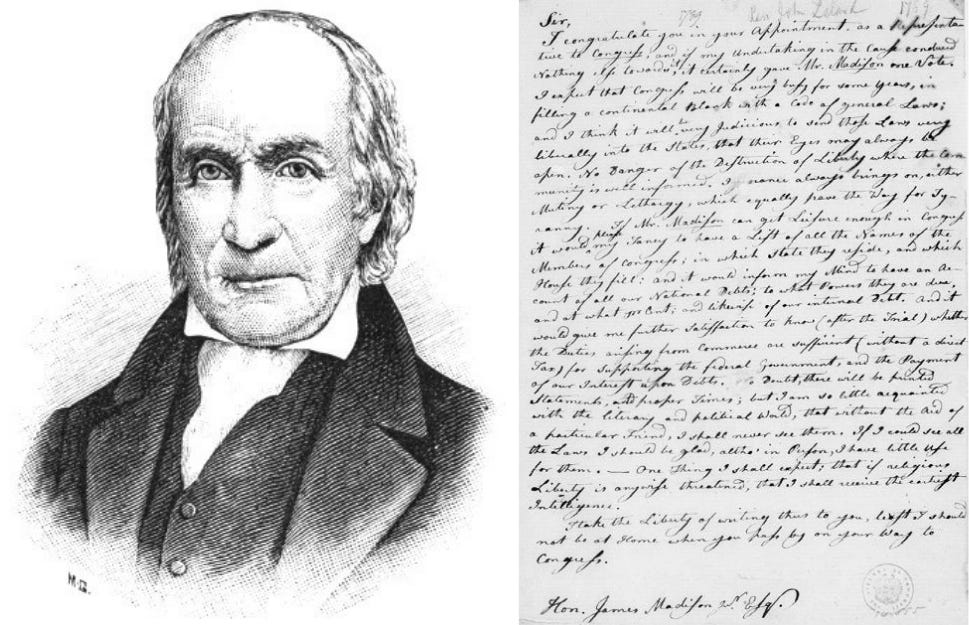
Leland wrote and spoke often on the importance of conscience, religious liberty, and separation of church and state. He repeated these arguments in various sermons and essays, making clear he saw the problem as much more than just an official state church (though he did find such a thing particularly devilish). For instance, in an 1804 essay he warned, “The fondness of magistrates to foster Christianity has done it more harm than all the persecutions ever did. Persecution, like a lion, tears the saints to death but leaves Christianity pure; state establishment of religion, like a bear, hugs the saints but corrupts Christianity and reduces it to a level with state policy.”
Right after his lion-bear argument, Leland added a line that would seem to perfectly describe Texas Attorney General Ken Paxton, who vigorously advocated for the “Ten Commandments” law while also making news for committing adultery, bearing false witness, and alleged theft. Leland argued, “Magistrates frequently love the advantages of Christianity more than the precepts of it.” And he blasted such magistrates for “lording over consciences, which is God’s prerogative and a favor which is not attached to their civil office.”
In another speech as he argued against Massachusetts’s state church and using taxpayer funds for sectarian purposes, he also noted other establishment problems that show he actually had a much broader definition of what non-establishment should mean. He criticized efforts to limit government leaders to Christians since other nations have found “these divine rulers will be the most cruel tyrants.” In particular, he pointed to the Crusades as an example of why we “should be fearful of attaching corporate power to religious societies.”
In that speech, Leland also criticized having a chaplain for the legislature (something James Madison also argued, and he knew a thing or two about the original intent of the Constitution). So if the Fifth Circuit truly wants to follow Leland’s definition of church-state separation, let’s go for it! Additionally, Leland argued against the need for laws to enforce the Sabbath or aid religious activities, again pointing out that all of this occurred pre-Constantine “without the aid of the law and the schools.”
I could go on — he was kind of prolific — but I’d say I’ve already proven my case.
