


During morning worship on Sunday (March 15) at First Baptist Church in Atlanta, Georgia, it came to the point of the service where Pastor Anthony George welcomes visitors and makes some announcements about upcoming activities in the life of the influential Southern Baptist megachurch. So he encouraged first-time visitors to pick up a gift bag, reminded the congregation about a “men’s breakfast” with him on Saturday, and highlighted the upcoming “Egg Stravaganza” later this month to kick off Holy Week with “inflatables, train rides, face painting, petting zoo, live parrots, balloon animals, and more.” He added they need donations to get 25,000 eggs filled with candy for that event.
In the middle of all that, George made a different kind of announcement that was tossed in like it was an important ministry effort. He recognized a Republican gubernatorial hopeful and had the politician, who was sitting in a reserved seat, stand up for applause.
“I want to tell you about a man that I just met for the first time right before the service, but I’ve gotten so many pieces of mail from him I think I already know him,” stated George, who took over the church after the retirement of Charles Stanley. “He is an extremely successful entrepreneur and businessman and has grown a massive healthcare company in Alpharetta in the greater Atlanta area and did a whole lot to prioritize Georgia with his resources during the COVID pandemic and the crisis and I think as a result saved many lives.”
“He recently has thrown his hat into the ring to contend to be our next governor. So, Mr. Rick Jackson, would you please stand? We’re very glad to have you here at our church today,” George added. “I can’t tell you how honored I was to get the call from your team that you wanted to come and be with us at First Baptist Atlanta. And he remembers Dr. Stanley and has watched closely the ministry of our church. ... So appreciate you, Mr. Jackson. Our prayers will be with you. And you have the one thing about it is he doesn’t need this. That’s for sure. And it’s a crazy time to be involved in public service, but we pray for him and for everyone who’s a part of that for God’s will to be done.”
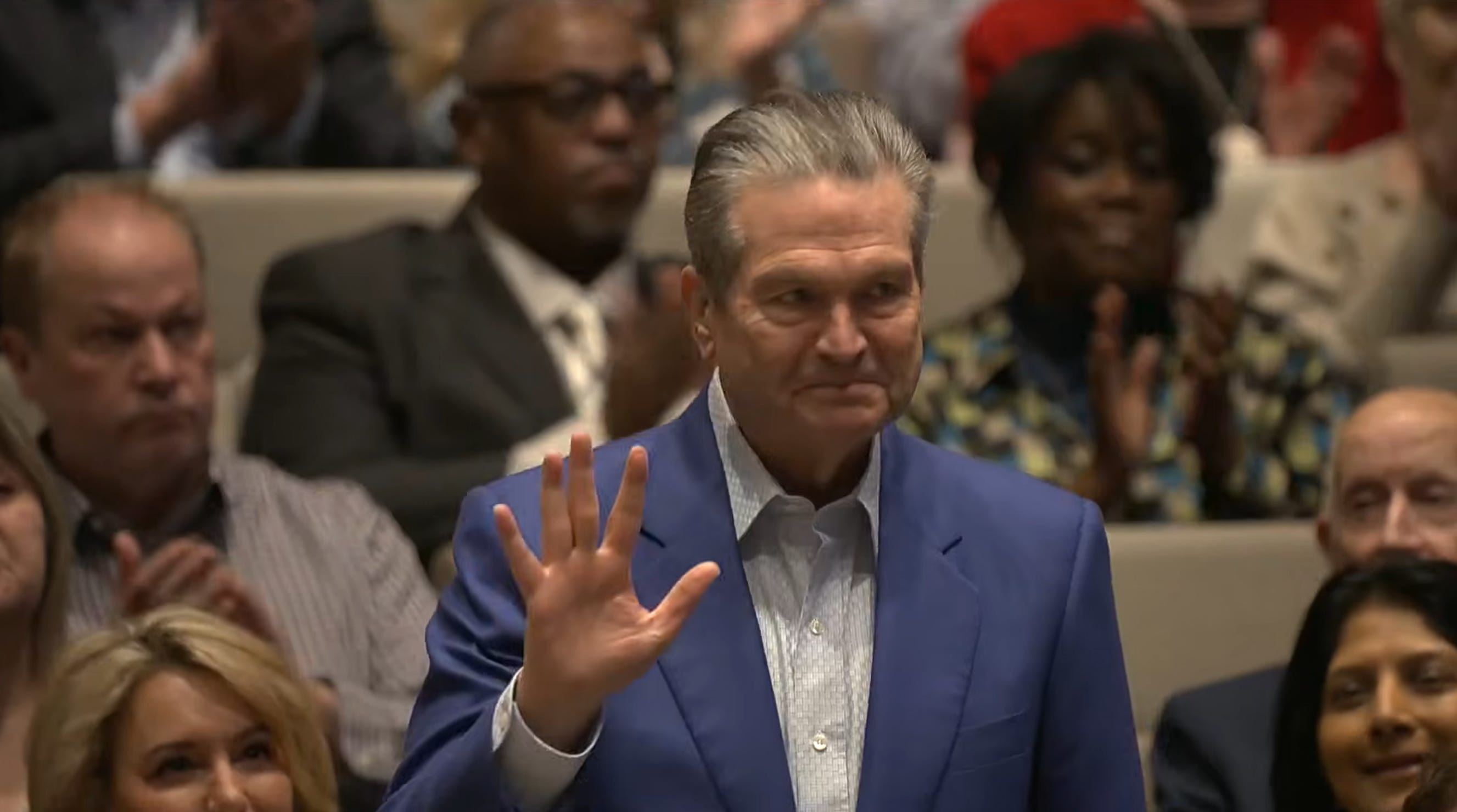
That moment in the middle of a church service with thousands present and thousands more watching online clearly violated IRS rules governing tax-exempt nonprofits like houses of worship. The IRS’s political campaign activity ban (more commonly known as the “Johnson Amendment”) prevents nonprofits from promoting candidates like George did for Jackson. And while President Donald Trump inaccurately bragged in his first term that he “got rid of the Johnson Amendment,” the law remains on the books. Yet, the IRS rarely enforces its requirements — especially against houses of worship.
It’s not new for George to turn Sunday worship into a campaign rally by literally interrupting the worship of God. George was one of several megachurch pastors in the state to feature U.S. Senate candidate Herschel Walker in a Sunday service during the former football star’s failed 2022 run. In that case, George even brought Walker on stage to talk during the service. George later hosted a prayer event for Walker on the morning after the campaign was rocked by news the candidate had previously paid for a girlfriend’s abortion (and A Public Witness broke the news about what was said during that event at the church).
Additionally, George has a history of spouting rightwing conspiratorial politics in his sermons and pushing Christian Nationalism at the church. So it’s not surprising that Jackson would come to kiss the ring or that George would be happy to boost a politician. But that moment in Sunday’s service tells us more about the contested Republican primary and the misuse of religious appeals. So this issue of A Public Witness heads down to Georgia to consider the devil in the details of this race.
Georgia On My Mind
As the gubernatorial hopefuls seek to rack up enough votes in the May 19 primary, there’s one number hanging over the race: 11,780. That’s how many votes Trump told Republican Secretary of State Brad Raffensperger he needed to “find” after the 2020 presidential election to undo Joe Biden’s victory in the Peach State. That phone call, which was recorded by Raffensberger’s chief of staff, was cited in Trump’s second impeachment and his indictment on 13 state charges along with 18 co-defendants who were accused of trying to illegally overturn the election.
Raffensberger, who won reelection in 2022 despite Trump backing a primary challenger, is now seeking the Republican nomination for governor. He’s currently running third behind Jackson and current Lieutenant Gov. Burt Jones. The previous Republican lieutenant governor, Geoff Duncan, was in office during the 2020 election and criticized Trump’s efforts to overturn the election results. Duncan is now running for the Democratic nomination for governor.
During all of the polling last year, Jones led the Republican race with Raffensberger in second. However, Jackson entered the race in February and quickly jumped to the lead. That’s despite the fact Jones already had the endorsement of Trump, many state lawmakers, and groups like Turning Point Action (the MAGA political organization founded by the late Charlie Kirk). Jones, who has highlighted his faith, is part of Rock Springs Church in Milner, a charismatic church led by Pastor Benny Tate. A Trump-backing pastor since the 2016 campaign, Tate was also one of the megachurch pastors who featured Walker during a Sunday service in 2022.
Yet, the billionaire Jackson who hasn’t held office before has quickly changed the race, especially after he dumped $30 million of his own money into campaign ads (which is several times more than any other candidate has even raised). Not only has he changed expectations about the race, he’s also injected some odd MAGA religious rhetoric. One of his first ads was a broadside against Raffensperger that compared the secretary of state to Judas (and since Trump is the one allegedly betrayed, you can complete the comparison). That spot ran not just in Georgia markets but also in Washington, D.C., and West Palm Beach, Florida (where Mar-a-Lago sits), thus showing he’s trying to win over Trump.
Earlier this month, his campaign released a four-minute-long “music video” that appears to be an AI band at a concert of AI fans singing a country-style song about him, his rags-to-riches rise, and his campaign promises. It includes lots of religious references about praying and church, and at one point even almost sounds like it’s being sung to God.
“I found a quiet refuge when the church choir started to sing. I took the punches, took the scars. Kept my eyes on who you are. When the world says stay down, you get up and stand your ground. I’ll fight the tough fights, win big for Georgia,” the AI band sings (with a bunch of AI young women fans singing along as if the song is really famous).
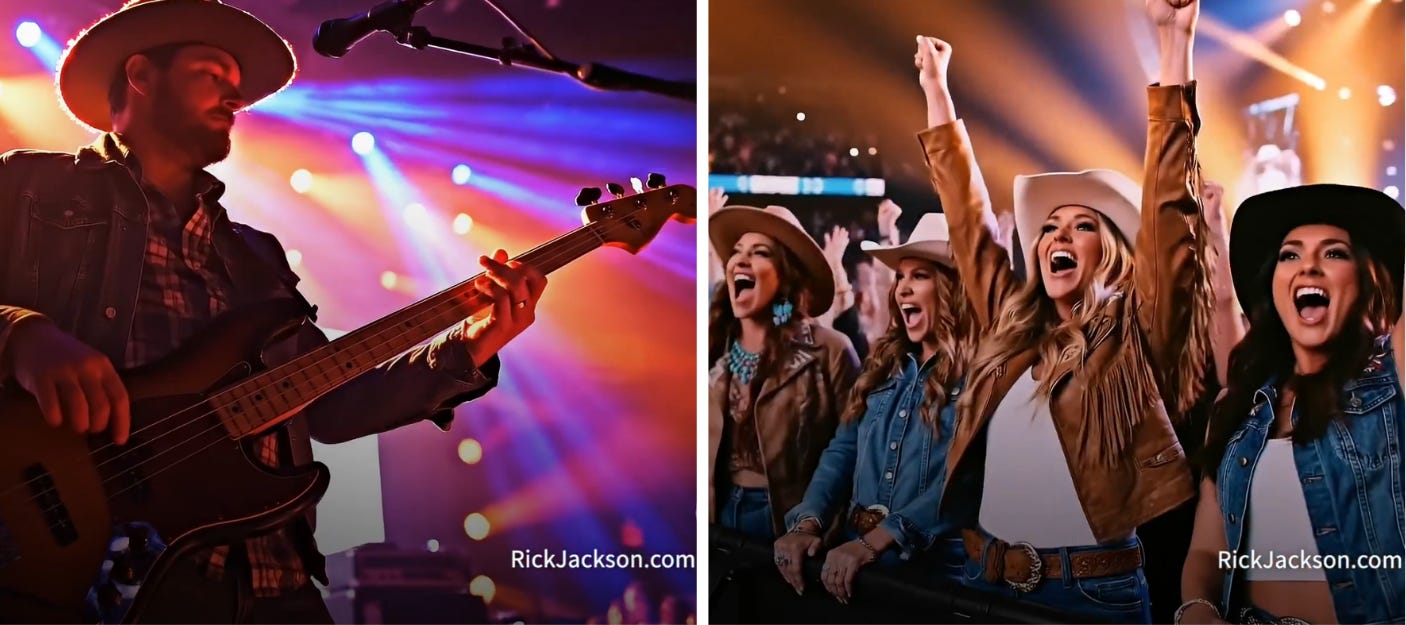
Jones mocked the AI band ad by posting a video of country star Jason Aldean performing at a Jones campaign event. Jones added as a caption: “No AI, just real people, real results.”
Jackson has pushed religion in other ways in his short campaign, including posting on Elon Musk’s X platform a photo of himself standing while being recognized during First Baptist Church’s worship service along with a picture of Pastor George posing with him.
He also justified his efforts to restrict access to public assistance programs by citing a Bible verse: “God created us to work, to build, to create — to help our fellow man. Work is a blessing, not a curse. 2 Thessalonians 3:10 ‘If anyone is not willing to work, let him not eat.’” (Conservative activist Alveda King also invoked during the January worship service at the U.S. Department of Labor.) Jackson hasn’t yet posted about a camel and an eye of a needle.
Not So Peachy
There’s nothing particularly surprising about First Baptist Church in Atlanta interrupting its worship of God to back a candidate for Caesar’s mansion. Nor is there anything especially unusual in Rick Jackson’s religious campaign appeals (other than his dumb AI music video). But that doesn’t mean we should pretend it’s all okay.
On any given Sunday this year, there will be a political candidate somewhere being recognized in a church or even brought onto stage to give some campaign remarks. Both Republican and Democratic politicians seeking political salvation in the midterm elections will try this strategy. But that doesn’t mean we should pretend it isn’t a profaning of the sacred space and time.
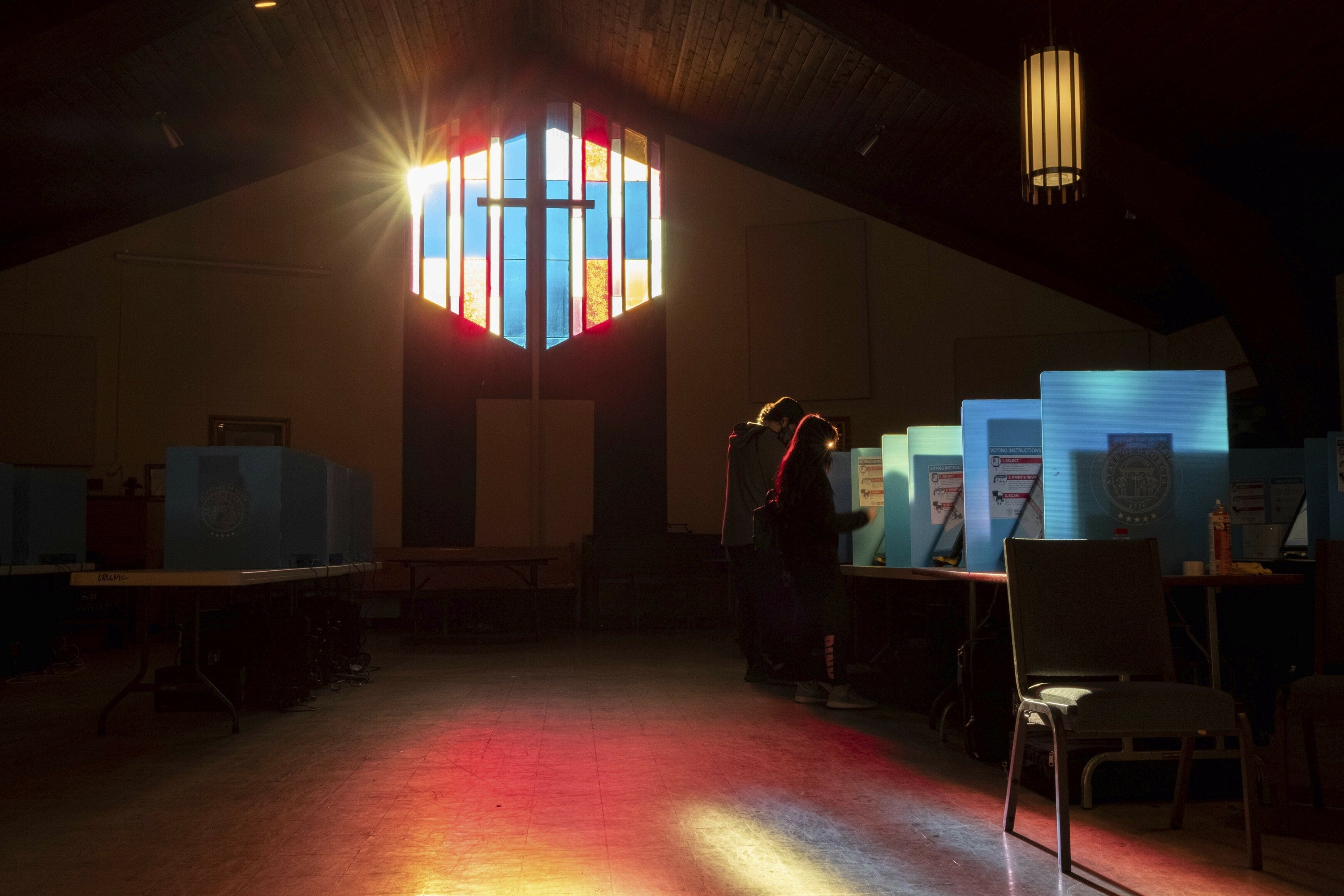
The scene at First Baptist in Atlanta on Sunday particularly highlights how candidates can abuse worship. There wasn’t a relationship here. The pastor even admitted he hadn’t ever met the candidate before getting a call from his campaign team about coming to the service. Clearly flattered, the pastor thought this proved his importance. But he failed to recognize the candidate was coming as part of a calculated political strategy. This visit wasn’t to honor the church or seek God but to use the church to win votes.
That’s why the IRS’s political campaign activity ban is actually good for churches. It’s not just a way to make sure candidates don’t get to funnel money through tax-exempt organizations; it also helps protect churches from being misused. Imagine the pressure a pastor might face from deacons or big tithers to say a good word about a preferred candidate. Or the temptation a pastor might face if a billionaire called up and promised to write a big check in return for getting recognized during Sunday worship. That would be even worse for our democracy and our faith than AI slop.
As a public witness,
Brian Kaylor
It is good to hear a real-life incident of misuse of the pulpit in favor of politics. In my experience, people in the church can be pushy to get candidates in front of congregations. Clearly in violation not only of our IRS laws but what we are called to be and do as a church. Lockstep with politicians is never a good policy.
First, and to be clear, I have a dislike of politicians showing up in a congregation during a campaign.
Second, you write as though this is a NEW phenomenon. These visitations have been happening throughout American history. I remember such visits as a child, even then thinking that it was odd.
Third, "Interrupting Worship" is a click-bait title and presents a false narrative. FBA, like most churches, has a period in the service for ANNOUNCEMENTS and the GREETING of guests. Maybe you have never been a church member, so it makes sense that it's a strange 'interruption,' as you think, and have questions. Perhaps, a little time and devotion to researching churches, the order of service, and church history would help to clear your confusion. Additionally, focusing solely on FBA makes your writing unbalanced. You should list SEVERAL churches, pastors, and candidates. (And tossing in the name of Charles Stanley, a man who left FBA in 2020 and who died in 2023, is a tired and worn practice. It's time to move on and face the present day. Let his name rest in peace.)
Fourth, it's quite rich and telling when you state "the pastor thought it proved his importance." Whose "importance?" The candidate's or the pastor's? Either way, that swipe is so biased, unnecessary, outside the scope of your argument, patently personal, and petty, that it calls into question your journalism ethics (if any are to be had). Further, it causes one to ponder if this platform is the extent and pinnacle of your writing career.
Tips: #1, Get a copy editor. #2, Stay on topic (Journalism 101).