


More than a week after Election Day, an unexpectedly tight race ended Wednesday night (Nov. 11) with a dramatic upset. The last Black senator from the Magnolia State was born into slavery and won the seat with the help of an influential pastor of the historic Black Baptist church where Sen.-elect Scott Colom is a longtime member.
Out of nearly one million votes cast, Colom narrowly defeated incumbent Republican Sen. Cindy Hyde-Smith by about 5,600 votes. Hyde-Smith, a graduate of a segregation academy with a Confederate-flag-carrying “Rebel” mascot, has been a senator since 2018. After President Joe Biden nominated Colom to a federal judge position in 2023, Hyde-Smith blocked him from getting the position. So he ran for her job instead.
In a year that saw many Democrats flip seats as they talked about their faith, Colom fit the trend. On his campaign website, Colom highlighted his faith, noting he ran because he’s “guided by his Christian faith and his love of Mississippi.” The biography also calls him “a lifelong member of Missionary Union Baptist Church in Columbus.” The church, which is part of the National Baptist Convention USA, celebrated his win on social media. While Colom is a member of a Baptist church founded by enslaved persons, Hyde-Smith is a member of a church in the Southern Baptist Convention, a denomination formed to support slavery.
During an interview on CNN last month, Erin Burnett noted how Colom frequently talked about his Christian faith in campaign speeches. Referencing other candidates also doing that — like James Talarico in Texas and Rev. Adam Hamilton in Kansas — Burnett asked Colom about how faith fits in the Democratic Party. He insisted that faith “always had a home” in the Democratic Party, “especially in Mississippi.”
“I grew up in the church. Sunday School is where I learned morals. My pastor taught me the values of looking out for your neighbor, treating people like you want to be treated, and actually serving the ‘least of these,’” Colom added. “What we got to do is make sure that we connect those values to our policies. So when I talk about raising the minimum wage, I’m identifying the fact that there’s dignity in work. When I talk about making sure people have healthcare and hospitals … every child of God deserves healthcare and hospitals. That’s something I owe my neighbor.”
“There’s nothing Democratic or Republican about Christian faith,” he added. “I know so many people that view their Christian faith through serving others.”
‘I Have Kept the Faith’
During his victory remarks Wednesday night that included multiple Bible verses, Colom started by talking about the power of prayer as he remembered the first of two previous Black Senators from Mississippi. Colom recounted that the first Black member of Congress from any state was Hiram Revels, who became a U.S. Senator from Mississippi in 1870.
The son of a Baptist preacher in North Carolina, Revels attended a Quaker seminary in Indiana and was ordained in the African Methodist Episcopal Church. Serving in several Midwestern states — including in Missouri, where he was imprisoned in 1854 for preaching to enslaved people in St. Louis — he was a Union Army chaplain during the Civil War. After the war, he became a minister in the Methodist Episcopal Church (a group that eventually became part of the United Methodist Church) and started preaching in Mississippi.
“The way he got to be a United States senator was he was a minister in Natchez, Mississippi,” Colom recounted at the start of his victory speech. “He was elected to be in the statehouse. And when they were trying to figure out who was going to do the opening prayer, someone suggested Hiram Revels. He gave a prayer that was so powerful that people at that convention decided that he had a voice to be United States senator.”
“That’s an example of the power of prayer,” Colom added. “And throughout our history, there’s so many people that lifted this state up through the power of prayer in very dark times. But we all know that prayer is only a part of our Mississippi faith tradition. You need faith. And I’ll tell you, throughout this campaign there were many times where I had to have faith.”
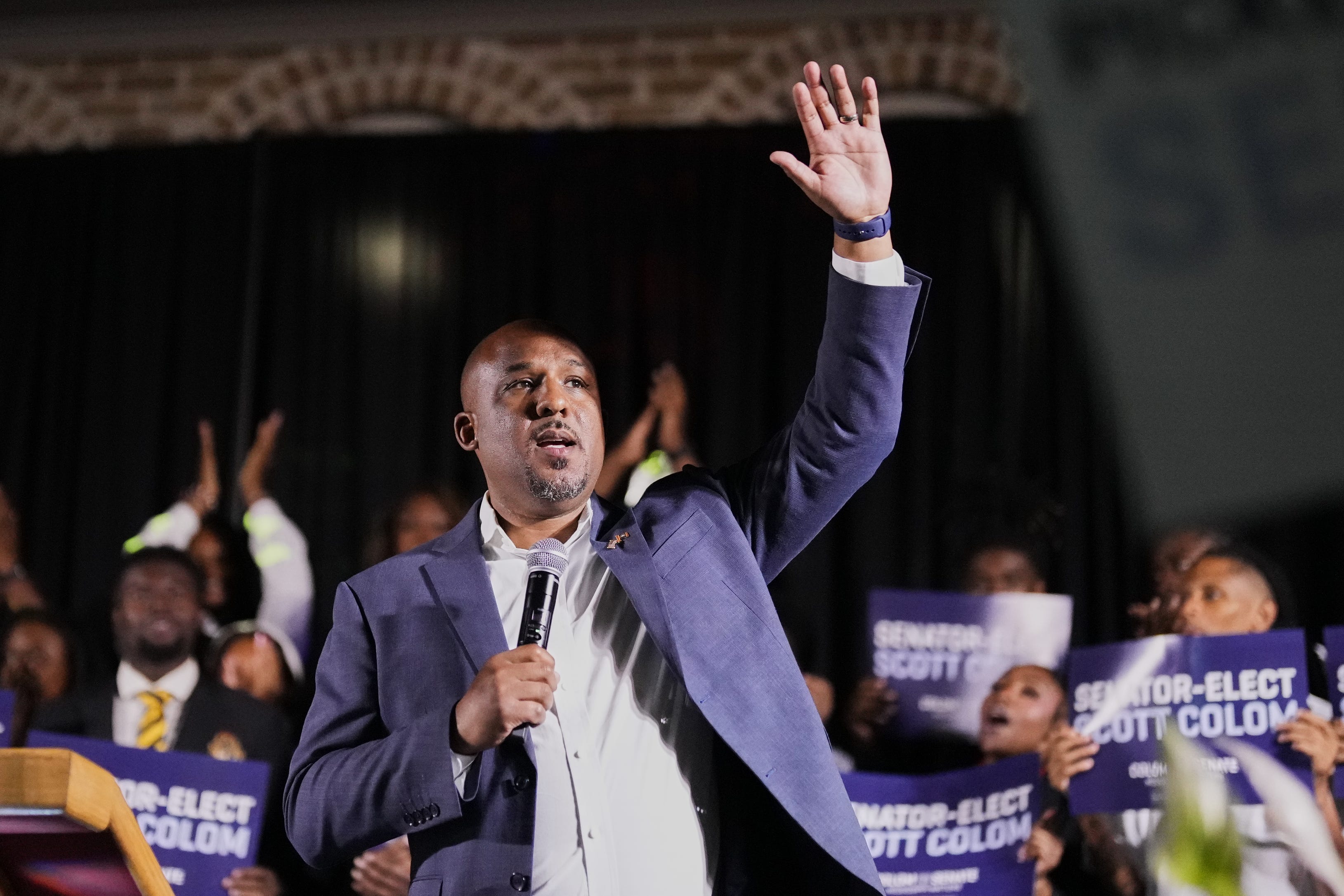
Recounting how he struggled to get donors to talk to him and when fewer than 10 people showed up at his first town hall in Jackson, Colom declared, “I kept the faith.” He then mentioned others who went before him who kept faith in Mississippi even when “it seemed impossible.” Like civil rights activist Medgar Evers, the first NAACP field secretary in Mississippi and who was assassinated in front of his house in 1963. Colom also recalled Fannie Lou Hamer, a voting rights activist in the state who worked to transform the Democratic Party in the 1960s and 1970s and ran unsuccessfully for a congressional seat.
‘A History that Needs to be Preserved and Told’
In addition to Revels, the only other U.S. senator to serve prior to 1967 also represented Mississippi during the period of Reconstruction. Blanche Bruce, who started his term in 1875, had been born into slavery in Virginia in 1841. Back then, state legislators elected U.S. senators, meaning Colom is the first Black man chosen by the voters of Mississippi for the U.S. Senate. Both Revel and Bruce had a key figure pushing their selection in the 1870s: Rev. Jesse Freeman Boulden, who was also a state legislator.
Born free in 1820 in Delaware, Boulden went to Quaker schools before converting to be Baptist. He pastored a church in Philadelphia before moving in 1860 to Chicago where he brought together two churches to become Olivet Baptist Church, the oldest operating Black Baptist church in Chicago (and that at one time claimed to be the largest Protestant church in the world). After briefly leading a church in St. Louis, he moved to Mississippi where he ministered for the rest of his life, other than a stint at Nineteenth Street Baptist Church in D.C.
One church Boulden led was Missionary Union Baptist in Columbus. The church traces its start to 1833 as enslaved people gathered for worship — making it the oldest Black church in northeast Mississippi and perhaps the second oldest in the state. But it wasn’t officially chartered until after emancipation. That occurred in 1867 under Boulden’s leadership.
While in Columbus, Boulden became involved in the newly formed state Republican Party and was elected in 1869 to the state House. William J. Simmons, an influential Black Baptist leader in Kentucky at the time, wrote in his book Men of Mark: Eminent, Progressive, and Rising that Boulden was made a candidate “against his will.” But once elected, Boulden decided one goal was “to get a colored man as near the president as possible; he concluded that the United States Senate was the place.” In that legislative role, Boulden helped organize the elections of both Revel and Bruce.
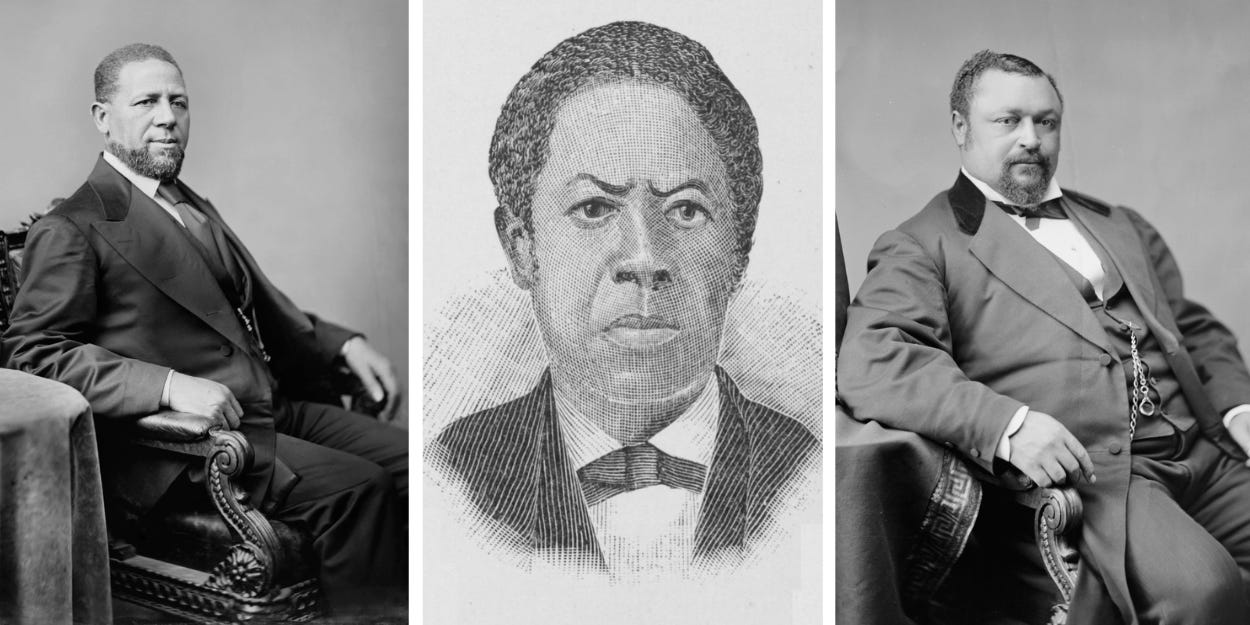
Later in his ministry, Boulden edited a Baptist newspaper and worked for the American Baptist Home Mission Society. Boulden, Revels, and Bruce all lived to see the short period of Reconstruction — and the legal and political freedoms it brought for Black Americans — come to an end with the rise of Jim Crow laws and an increase in lynchings and other racist terrorist acts. This shift occurred during Bruce’s single term as a senator, resulting in him being replaced by a former enslaver and Confederate general.
For the current pastor of Missionary Union Baptist Church, it’s important to know the history of the church as enslaved persons started it, Boulden officially organized it during Reconstruction, and people kept it going through Jim Crow.
“When you don’t know where you come from, you really don’t know where you’re going,” Rev. Derrick Fields said. “Within that church body, there are a lot of firsts. That is a legacy and a history that needs to be preserved and told, particularly in this time of erasure.”
Adding to that history, nearly 150 years after the state’s last Black senator left office, someone who grew up in the church chartered by Boulden will assume the seat previously held by Revels.
As a public witness,
Brian Kaylor