


Much has been written about the influence conservative White Christian men have had on American culture. However, the women who operate within this sphere have also had a sizable impact of their own.
Turning Point USA’s Erika Kirk has begun to command a large following after her husband, Charlie Kirk, was assassinated just over one year ago. Authors like Allie Beth Stuckey and Megan Basham have written best-selling books deploring the perceived excesses of the political left and promoting their view of traditional Christian gender roles.
There’s a clear need for scholars to explore how women like this have made space for themselves within a patriarchal landscape and how the concept of “traditional” White Christian womanhood developed in the first place.
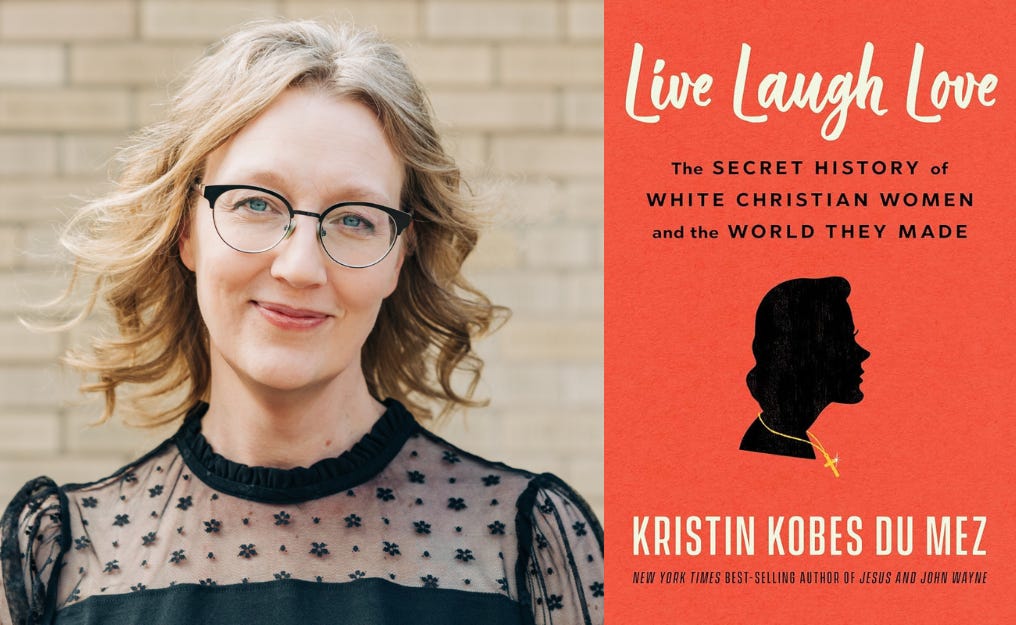
In her book Live Laugh Love: The Secret History of White Christian Women and the World They Made, Calvin University historian Kristin Kobes Du Mez works to fill this gap in the scholarship. She traces the history of White Christian womanhood from the late 19th century to the modern day.
While being subservient to men, Du Mez shows how, through consumer culture and politics, White Christian women amassed power for themselves by upholding the power structure. However, these figures risk being stripped of this power when they step outside of subordinate roles in the patriarchy.
Contributing writer Kenneth Ethan Frantz recently spoke with Du Mez about her new book, the formation of White Christian womanhood, and how her work connects to the ongoing conversation about “Biblical womanhood.” The following interview has been edited for length and clarity.
Kenneth Ethan Frantz: It is a book about White Christian women, but it is also very much a book about capitalism and Christian consumer culture. Would you mind talking about how you see those things as intertwined?
Kristin Kobes Du Mez: One of my regrets in writing Jesus and John Wayne is that I did not adequately grapple with the economics of that story and situate that story within a broader economic history. And so I tried to make up for that in Live, Laugh, Love.
When you’re looking at cultural products, and in this case the Christian products industry, you have to think about money changing hands, but the story goes deeper than that. It also looks at how particular theologies and ideologies were useful to and amplified by corporate America.
So I look at in the 1930s and ‘40s, for example, how corporate interests united with certain religious leaders to promote an individualistic interpretation of Christianity and really push back against the social gospel tradition that had critiqued corporate power, inequality. And what happened was that an individualistic evangelicalism and philosophy of positive thinking were ideally suited to promote free market capitalism.
And you see this growing alignment in the ‘30s, ‘40s, ‘50s, up to the present. And I think that’s a really critical backstory so that you can understand how now generations of Americans, and particularly American Christians, have accepted essentially the gospel of free market capitalism.
KEF: I also saw throughout the book that there is an ecumenical, interfaith strand throughout the book, like Mormons, Catholics, mainliners, but also New Thought. How is the interfaith element important to the story?
KKDM: What I realized early on was that the neat and tidy categories that scholars of American religion like to work with simply didn’t apply to the story that I was trying to tell. Early on, so already in the late 19th century, you see both similarities and then influences going back and forth between New Thought, which evolves into the philosophy of positive thinking and Holiness evangelicalism. And you see an emphasis on health and faith healing that feeds the charismatic movement, but you see this parallel movement going on inside New Thought.
You see a shifting emphasis gradually in both traditions around not just health, but also wealth. And so really it’s a story of porous boundaries. That certainly is the case in the 20th century around ideals of femininity, where you can see the direct influence between ideals of femininity popular in New Thought spaces influence Mormonism and influence evangelicalism.
And so ultimately one of the threads of the book is showing how “biblical womanhood” and popular ideals of femininity in evangelical spaces have a much more complicated pedigree than evangelicals would have you believe. And there’s much more to these ideals than simply biblical influences. So yeah, I will also say that the closer I looked at figures like Billy Graham, Oral Roberts, Norman Vincent Peale, the more I saw similarities in their teachings rather than seeing them as participating in these very distinct traditions. And what I realized is that they saw it themselves.
So one of my chapters is called “Different Sides of the Same Street,” and that’s a quote from Norman Vincent Peale, recognizing that he and Graham are undertaking essentially the same project, but in different spaces. And I throw Oral Roberts into that mix as well. And so it’s really a reconceptualization of 20th century American religion and understanding how what we thought were largely distinct traditions are working towards the same end.
And in the mid-century, that was promoting free market capitalism, individualism, pushing back against New Deal liberalism, and against any real conception of structural inequalities that might need to be addressed socially, politically, or even theologically.
KEF: You’re a historian, so in the book it covers a wide range of time. You also just mentioned you cover a variety of different people. So would you mind going into the logic of the case studies you chose, what you excluded, what you included, and why?
KKDM: Yeah, it started off where I had a sense of some of the women who are going to be important in this story. So I started off with women like Catherine Marshall, the author of the book, Christie, and a number of other books. And she, by the way, is situated in the mainline. And then also Elisabeth Elliot, I knew was going to play a role. I did not know exactly the role that she was going to play when I started researching this project. She became just fascinating to me. And I knew women like Amy Grant, Sandi Patty, these sorts would have a place. And then I knew going up to more contemporary times, Beth Moore, Joyce Meyer.
So I started off with a number of women that I knew were part of this story because of their prominence. And then as I began to dig into their life stories, and first, just read their writings, I started adding more women to the list.
And one of the most important women that I added who wasn’t on my radar when I started this project was Hannah Whitall Smith. So going back to the 19th century. And what led me to her was the writings of Elisabeth Elliot, of Catherine Marshall, of these women that I knew were important in the ‘60s and ‘70s. And they kept citing her, they kept reissuing her book, writing adaptations of her work themselves. And so that really drew me back to the 19th century.
So it was just kind of standard research. But as I began to dig into these life stories, that’s where I started to see the connections. The connections between figures that I had never imagined were connected. And through these connections, I began to see the shape of the larger narrative. So I mean, it took me five and a half years, and it’s just a research project that began in one place asking some questions with some ideas, and it took me in all sorts of directions that I hadn’t anticipated.
But by the time I finished, I felt confident in the power of this narrative and the pieces that fit together. That said, there were so many figures who could have also been added to this. And some were painful to leave out. But already I know that I’m pushing the limits of what I’m asking readers to sit with. There are so many names in this book and many names that will be familiar to some, and then many that will be completely unfamiliar.
In some chapters, the women that I highlight really are representative and could be swapped out with others, many others. And then in some cases, they are really significant. So somebody like Elisabeth Elliot and Catherine Marshall, both of them really couldn’t be swapped out for somebody else. In part because they’re really creating the system. Whereas other women, particularly later on, are inhabiting the system that is already up and running.
KEF: You cover some people that some might consider quite fringe and outside of the realm of mainstream evangelicalism, like Doug Wilson, Bill Gothard, and R. J. Rushdoony. Would you mind talking about why you chose to include those people and how they connect to mainstream, I guess, White Christianity?
KKDM: I guess I hear fewer people these days claiming that these figures are fringe. I think that was more common to hear 10 or 15 years ago. They enter this narrative because one of the themes of the book is there’s always a tension between the power of the spirit, individualism, human agency, whether it’s in New Thought, positive thinking, mind controls reality, or Holiness evangelicalism where it’s each individual believer has within themselves the power to believe, trust and obey, and then you’ll be blessed with holiness and happiness, this kind of formula.
That can be really empowering and it can also be really disruptive. And you can see that in the early history of Pentecostalism, for example, where you have women and Black Christians, believers, and the poor, and those on the fringes of society claim the power of the Spirit. It can be very disruptive.
And I would add James Dobson into that mix who would not be considered fringe and Doug Wilson. And what you see then is their teachings of rigid hierarchy and control and of defining women’s faithfulness, not in terms primarily as submission to God as Hannah Whitall Smith did in the 19th century, but submission to the authorities God has placed over you, submission to man.
That is this critical move that ends up shaping the lives of millions of women so that they perceive faithfulness in terms of submitting to the “God ordained authorities” and all that entails in terms of their identity, in terms of vulnerability and so on. So those figures play a role in this story in reasserting control. And I think that it will become clearer and clearer how influential they were and how influential they have been up to the present day.
And particularly somebody like Rushdoony, that for a long time scholars have just, oh, he’s fringe. He’s the “crazy uncle” of evangelicalism. Well, look at his influence. Look at his influence through Howard Phillips and the Council for National Policy right there, defining the Christian right politically and this vision for what it means to take America back for God, if you will.
The influence we see today is somebody like Doug Wilson. But the reason he’s being elevated at this point is because of his subtle influence, or not even subtle, his profound influence beneath the surface, reaching into conservative denominations, conservative churches for decades now and through his networks.
So yeah, I would contest that these figures are fringe. They are not the whole story. And I think one thing that Live, Laugh, Love does is by providing such an expansive account, you can fit figures like this in and see their influence inside their spaces and then beyond.
One more thing I would say with Rushdoony is his influence is not just in traditionally reformed spaces where it started, but we can trace his influence through charismatic spaces as well. And the dominionism that we see promoted by New Apostolic Reformation prophets and apostles. So yeah, I find it hard to support the claim that somebody like Rushdoony is fringe at this point, unfortunately.
KEF: You did mention even though a lot of Christian leaders didn’t like the economic form of communism, they did kind of draw a lot of control techniques from the communist movement. So how did that come into your narrative of White Christian women?
KKDM: That was one of the unexpected twists and turns of this research. I mean, anybody who studies post-World War II evangelicalism knows that it’s all about anti-communism. You listen to a sermon, you’re going to hear about the threat of Soviet communism. And I knew that. I wrote about it in Jesus and John Wayne, Billy Graham and so forth.
This time around, I started paying a little bit more attention to what they meant by that, and particularly what they meant when they said that the only antidote to communist totalism is an evangelical totalism. That the allure of the communist worldview was so powerful that what was needed was a totalizing system that would draw people into what was good and true to Jesus, to Christianity, and away from that totalizing ideology of communism.
What did they mean by that? What did they then set out to build? Organizations like Campus Crusade, how was that structured around individual cells, small groups, recruitment tactics? When I would hear people who have been part of these organizations talk about both what the organizations provided them and what these networks and communities provided them in terms of sense of belonging and identity, and how difficult it was to leave those organizations and the mechanisms of power used to control behaviors.
That’s when I realized that we needed to take them at their word when they said they wanted to offer a totalism of their own to combat Soviet totalism. So there’s a lot of receipts in the book for what that looks like. And I think that that section will resonate with a lot of readers who have been in these spaces and experienced both the good and the bad of these spaces. A profound sense of belonging and meaning and purpose. When they cross a line that they maybe didn’t even know existed, how they feel the other side of the equation.
KEF: A lot of the products, consumer culture, a lot of the products White Christian women consumed from the late 19th century to today did tell them to be submissive, be gentle, almost act like children and be afraid of cows and pout when you don’t get your way. Would you mind talking about how that developed and how that might contribute to this notion of women being controlled?
KKDM: I think it’s easiest to control people when that control does not appear to be coercive, but rather when it promises rewards, when it promises happiness. That’s how you draw people into systems when you promise that it will be for their own good and that they will benefit, that they will be “empowered.” And I think that’s what this feminine ideal does for women.
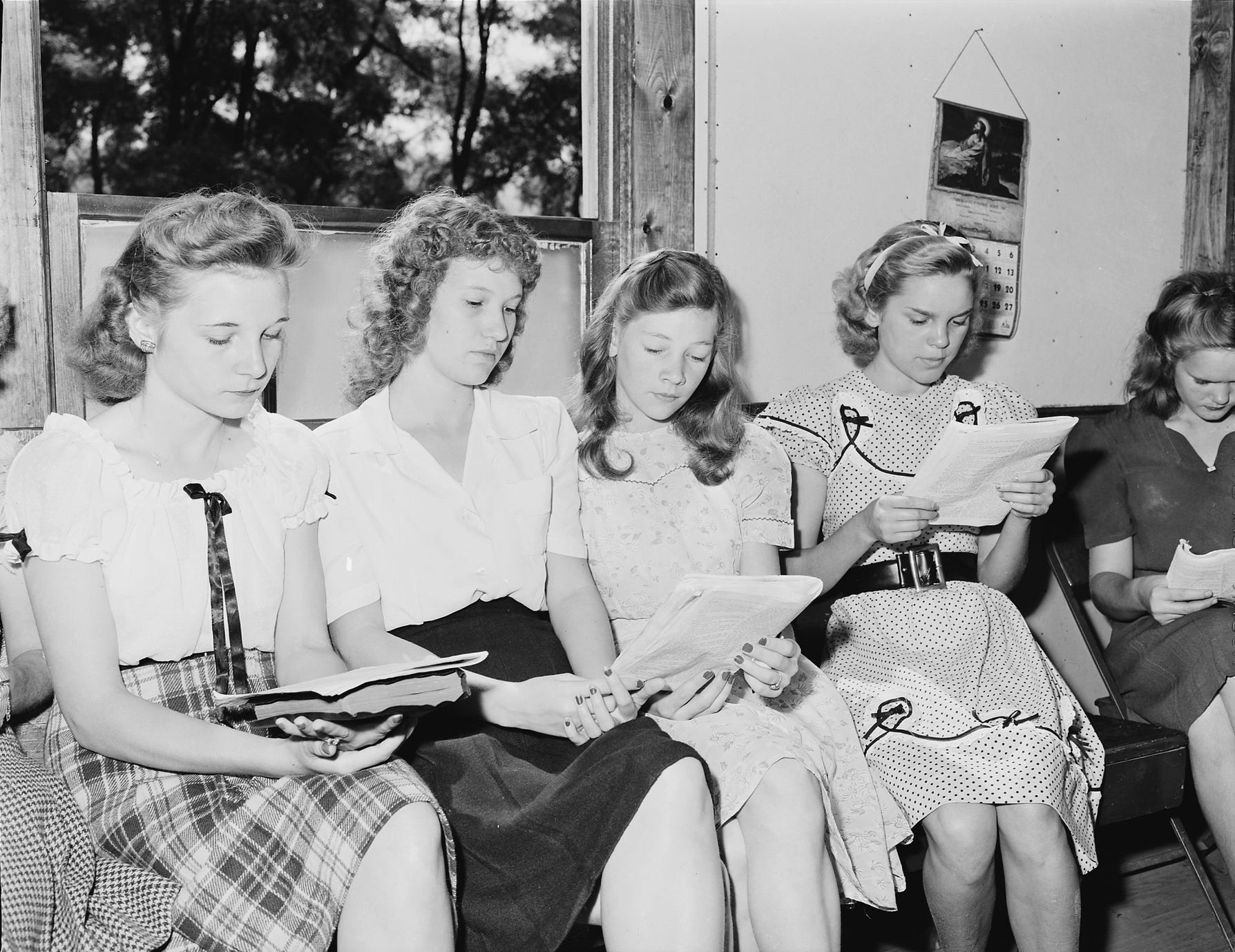
It emerges in the early 20th century. I trace this particular ideal of fascinating womanhood to the early 1920s, a publication called Fascinating Womanhood that was published by a New Thought publisher, so not explicitly Christian. And it presented a view of femininity based on a law of attraction, this New Thought concept that if you are attractive, you will attract good things to yourself. This is a law of the universe. For women, that meant you need to be beautiful, and you need to be charming.
And to be beautiful and charming meant to adore men and to never challenge their ego and to turn yourself into a childlike woman, a woman child really, who is kind of half angel, half child. And when you were able to win a man’s affections, he would give you what you most wanted, which was a happy marriage and money and things and all the material blessings, if you will.
This was an entire handbook for how to behave. So yes, when you go on a date, first of all, absolutely pay attention to your appearance. Beauty is everything. And then when you attract a man enough to go on a date, try to get him to take you off the beaten path so that you can feign incompetence more easily and allow him to feel important and strong and brave. It’s a lot of performativity, not authenticity.
To be a successful woman requires appearing to be incompetent, silly, frilly, feminine, but that is your path to empowerment. So it’s a silly set of booklets. It doesn’t become a massive bestseller, but it travels through an almost underground network. Gets passed down usually from mothers to daughters who say, yes, this is the key to marital happiness. And then it reemerges in the 1960s in Helen Andelin’s book, Fascinating Womanhood, very closely based on the originals.
And then that book directly inspires Maribel Morgan’s Total Woman, which in turn really sets the template for decades of writings on Christian womanhood. So this is where it comes from. How does it control women? It promises women that if you follow these rules, you’re going to be happy and you’re going — this is the path to women’s power.
KEF: This book does kind of contribute to an ongoing conversation on biblical womanhood or White Christian womanhood. Other authors like Beth Allison Barr comes to mind. Do you see your work as connecting to the two books she’s written recently?
KKDM: I cite her. In some ways, we are coming at the same question from different disciplinary places, or not disciplinary, but from different subfields within the discipline of history. And that question is really questioning the purported timelessness of evangelical ideals of quote unquote “biblical womanhood.” That as historians, we know things have not always been the way they are now. And we know that Christians over the course of Christian history have come up with ideals of Christian womanhood and ideals of femininity that look very different from the current ideals that go under that brand of biblical womanhood today.
Beth knows that because she’s a medieval historian and she’s spent her life studying medieval women who have been throughout Christian history renowned for their faithfulness, whose lives look absolutely nothing like the ideal presented in modern evangelical books on womanhood. So that’s kind of her entry point.
Beth then brings it up to the present and does this as well. I don’t go as far back, but what I’m looking at is the title of her first book in this trilogy. She’s written other books, but The Making of Biblical Womanhood, that’s where I come in as a 20th century specialist to show how these pieces got put into place, where they came from.
What we do as historians, showing how things came to be, is extremely disruptive in spaces that presume to be working with God-ordained concepts handed down from God who tend to deny any kind of hermeneutic. All right, this is the plain reading of the scripture, and who have worked to develop a kind of closed system inside their spaces. There are approved readings and then anything on the outside should not be trusted. And what we are able to do is our work has broken into some of those spaces and demonstrated how these purportedly timeless “biblical constructs” have a human history.
End of the day, I would say that the historical work that I do, while disruptive, does not in fact answer the question of who is right here. Which one is the most biblical? Which one is the only right? I guess it would push back on anybody’s confidence that their particular view is the only right Christian view. And they can still hold that, but they just can’t hold that and say, “And it is timeless and eternal.”
So I think that’s the kind of work that we do. My book of both of my books are our books, mine and Beth’s, they’re very much in conversation with each other, but kind of approaching this from different angles.
KEF: And a theme that comes up in both Jesus and John Wayne and in Live, Laugh, Love is amassing power and abusing power. In the last chapter in Live, Laugh, Love, you do talk a bit about abuse in the Southern Baptist and the Assemblies of God. And so would you mind, how does this concept of biblical womanhood, as you see it, contribute to a lot of the abuse that’s being uncovered in these major Christian denominations?
KKDM: This idea of biblical womanhood, first and foremost, is about submission to male authority. And so it makes women susceptible to abuse in their own homes and churches. It also teaches women to accept their circumstances and that suffering leads to holiness, and it rewards loyalty to the brand and punishes those who challenge the authority of those at the top of the system, those pastors and leaders, or in a household, husbands. So it certainly sets up a framework that makes women vulnerable to abuse and makes it very difficult for women to report abuse.
And importantly, for communities of faith to then respond in appropriate ways once reports do surface. And this is something I address in Jesus and John Wayne, and again, in Live, Laugh, Love, that for a community that claims to value sexual morality so much and sexual purity, how can we explain the fact that the standard pattern to handle allegations of abuse inside these spaces is to minimize those allegations, to support the predator, to require quick forgiveness. And if the victims do not comply and keep speaking out, or if they want to see justice, then the result is ostracizing the victims.
If you are just looking at beliefs like sexual morality, you’re not going to have an answer to that question. You have to look at the power dynamics that were built into these systems and then taught as God’s will. And women themselves were taught if you disrupt these power dynamics, you are sinning against God. And these are faithful women who want to obey God, and that’s how these systems work. So that’s what I tried to bring to light, just reading the sources.
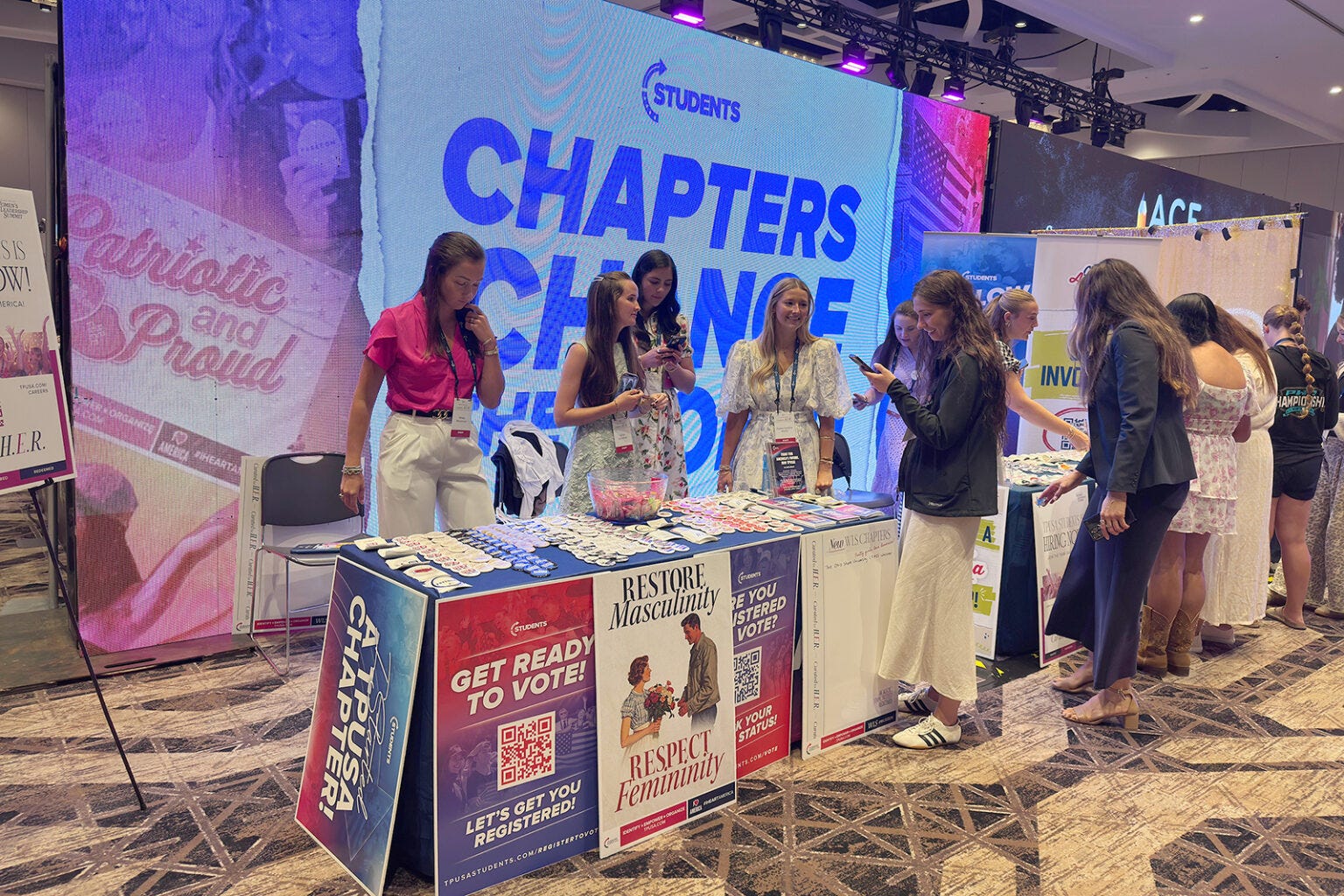
KEF: Some women have managed to amass power for themselves through these norms of White Christian womanhood, like Erika Kirk, Kristi Noem, and Allie Beth Stuckey come to mind. So would you mind talking about that and how they prop up the system?
KKDM: There’s always a place inside these systems for women themselves to support and defend the system. And then this is where the performativity is so crucial. You need to perform femininity; you need to perform submission.
I think of Phyllis Schlafly famously thanking her husband for giving her permission to speak whenever she would speak publicly, these sorts of things. That women who follow all the rules and play this crucial role of discipling or indoctrinating, choose your verb there, women into this system are rewarded with considerable power.
But as the case study of Anita Bryant makes clear, as soon as you step out of line, that power is taken from you. And it is always power within constraints. You are empowered to promote and defend the ideology, the system. And this only works with women on the front lines promoting and defending this ideal of femininity and submission.
Kenneth Ethan Frantz is a freelance writer and a doctoral student in sociology at the University of Oklahoma. You can follow him on Bluesky @kennethefrantz.bsky.social.