


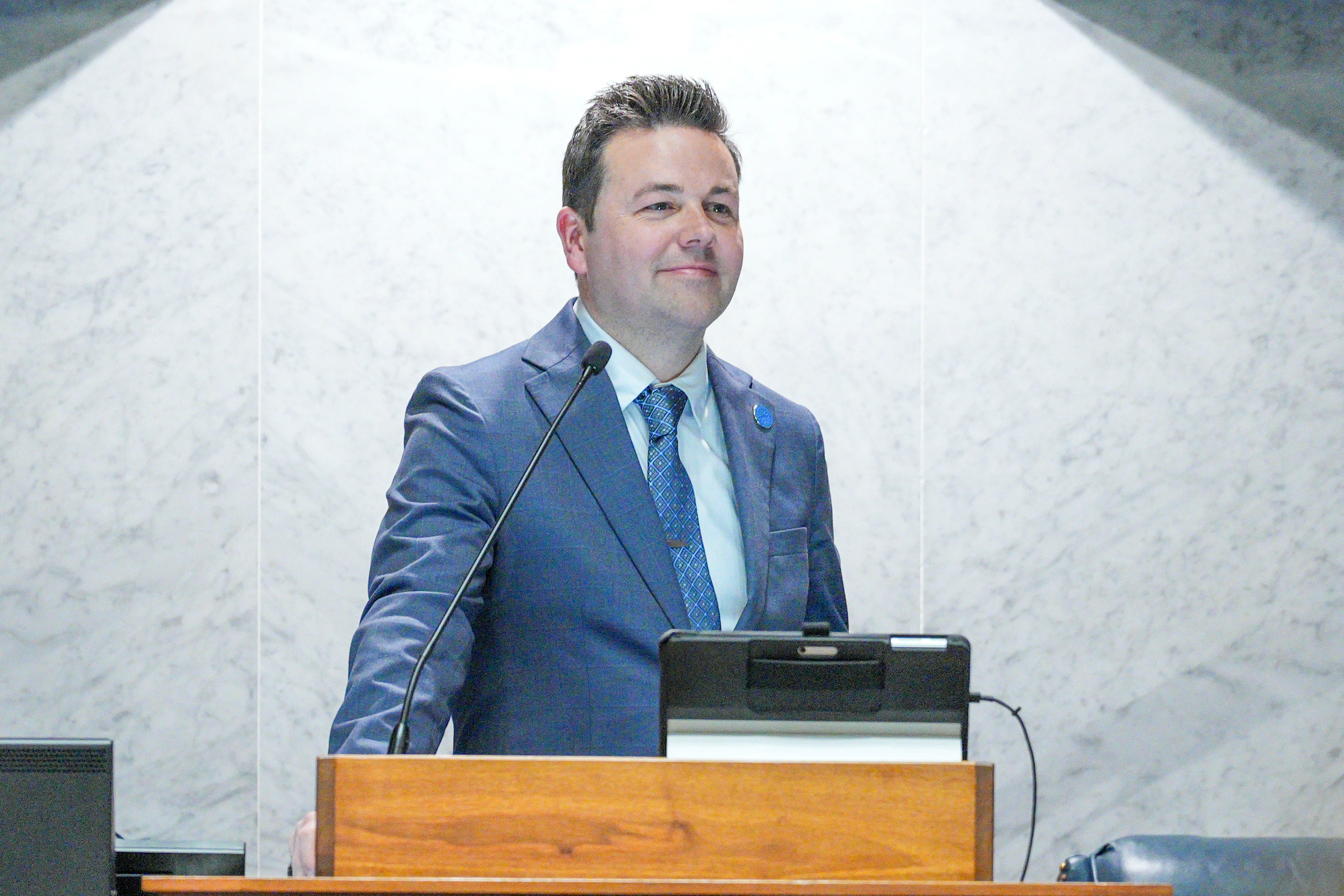
The Republican lieutenant governor of Indiana wants to change his state’s Constitution to bar non-Christians from holding public office. A Christian Nationalist pastor who won his spot as part of the gubernatorial ticket with then-U.S. Sen. Mike Braun in 2024, Micah Beckwith isn’t shy about his hope of transforming the country into a supposedly “Christian” nation. And he thinks one way to do that is to impose a religious test for office.
“I want to go back to the way it was in the first 13 state constitutions, because there was a public declaration required in Judeo-Christian orthodoxy in order to hold office, because we are a Christian nation,” he argued during a recent town hall in a church. “That doesn’t mean you have to be a Christian, doesn’t mean you have to swear allegiance to Jesus Christ as your Lord and Savior. It means you recognize what the foundations of this nation are. I would love to see that.”
I’m honestly not sure what his test would look like. While he tried to say they wouldn’t have to be Christians, only Christians could actually affirm “Judeo-Christian orthodoxy.” Additionally, his historical examples were often clear about requiring a Christian affirmation.
As usual, Beckwith gets a few of the details wrong. There wasn’t a religious test in all of the constitutions for the first states, though there was one in most of them. None of them talked about a “Judeo-Christian” faith system as they were instead requiring someone to be Christian or even part of a denomination in order to serve in office. In Maryland and Massachusetts, one had to declare they were a Christian. In Georgia, New Hampshire, New Jersey, and North Carolina, one had to be a Protestant. In Pennsylvania, one had to say they believed in God and affirmed the “divine inspiration” of “the Old and New Testament.” In Delaware — which took the whole religious test thing to another level — one had to “profess faith in God the Father and in Jesus Christ his only Son and in the Holy Ghost, one God blessed for evermore” and “acknowledge the holy scriptures of the Old and New Testament to be given by divine inspiration.”
That’s the history Beckwith said he wants. However, after being reminded that the Hoosier State had never had such a test and explicitly bans them in its Constitution, he quickly clarified he wants a constitutional amendment instead of just a legislative measure.
Beckwith also leaves out the part of the story where we got rid of those bigoted tests for office. While such tests were a regular practice in the British government and its colonies, the only religious reference in the original U.S. Constitution before the amendments was an explicit prohibition against such tests. Even before the First Amendment, our founders were separating church and state in this key way. Rejecting religious tests for office is foundational to who the United States is!
Unfortunately, Beckwith isn’t alone. Other politicians and preachers pushing Christian Nationalism have also floated the idea of undoing the American experiment that banned religious tests for office. Like Doug Wilson, the self-described “paleo-Confederate” Idaho pastor who started the denomination that Pete Hegseth is part of (and who Hegseth had preach during the February 2026 Pentagon worship service).
As a result of the advocacy of figures like Wilson and Beckwith, it’s worth remembering why the American experiment includes a ban on religious tests for office. So this issue of A Public Witness swears to tell the truth about how the Christian Nationalist vision flunks an important democratic test.
‘Greatest Engine of Tyranny’
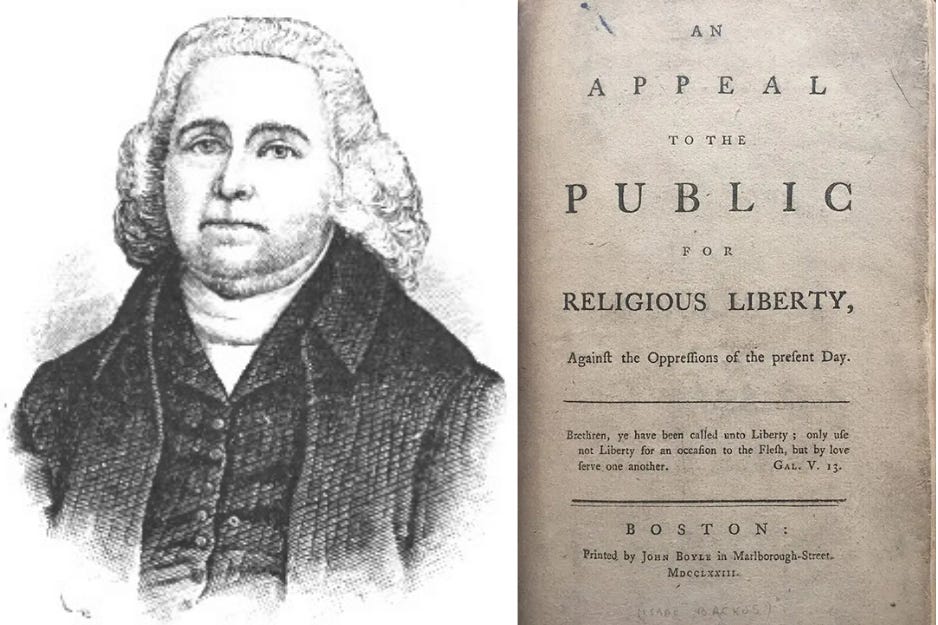
After Roger Williams and John Leland, Isaac Backus was probably the third-most important Baptist voice for religious liberty during the colonial and founding era of the United States. A Baptist pastor in Massachusetts from 1751 until his death in 1806, he was among those who started the school that eventually became Brown University. An outspoken advocate for religious liberty, he published various tracts on the subject and spoke before colonial and national groups as he sought an end to religious taxation that supported official colonial churches and an end to religious persecution by civil authorities. He served as delegate to the Massachusetts convention that ratified the U.S. Constitution in 1788. He voted for the new Constitution after specifically praising Article VI for barring religious tests for office.
“Nothing is more evident, both in reason and in the holy Scriptures, than that religion is ever a matter between God and individuals, and therefore no man or men can impose any religious test without invading the essential prerogatives of our Lord Jesus Christ,” Backus told his fellow delegates. “Constantine approved of the practice when he adopted the profession of Christianity as an engine of state-policy. And let the history of all nations be searched, from that day to this, and it will appear that the imposing of religious tests hath been the greatest engine of tyranny in the world.”
Backus also praised the new Constitution for “excluding all titles of nobility or hereditary succession of power” since “all men are born with an equal right to liberty and property, and that officers have no right to any power but what is fairly given them by the consent of the people.” For him, the religious freedom enshrined in Article VI’s ban of religious tests was an essential part of the new American experiment.
It’s significant that Backus made this argument in Massachusetts. The colony-turned-state had a long history as a Christian Nationalist place where church and state were joined together. It would be the last state in the new nation to disestablish its official state church. And it had long been a place of religious discrimination against Christians who didn’t belong to the powerful Congregational Church. Massachusetts Bay Colony banished religious dissenters like Puritan minister John Wheelwright, Anne Hutchinson, and Roger Williams. The latter, forced into exile, founded the first colony with religious liberty for everyone (Rhode Island), cofounded the first Baptist church in the Americas, and pushed for church-state separation. Colonial leaders in Massachusetts even executed Mary Dyer, William Robinson, and Marmaduke Stephenson for being Quakers. If you can’t get along with the Quakers, that really says more about you than them!
Given that history, it’s not surprising that the issue of religious tests for office was one that multiple delegates addressed during the Massachusetts convention that voted for ratification. But Backus was not the only voice to praise Article VI. And some of the arguments for the prohibition are particularly prescient.
Theophilus Parsons, a lawyer and son of a minister, emphasized two important points: the religious tests would not prevent a dishonest person from saying what they needed to in order to obtain an office, and this would place the new government in the position of deciding what it means to be a Christian. Instead of a religious test, he urged people to pick leaders based on the moral character of their lives.
“It has been objected that the Constitution provides no religious test by oath, and we may have in power unprincipled men, atheists, and pagans,” he told his fellow delegates. “No man can wish more ardently than I do that all our public offices may be filled by men who fear God and hate wickedness, but it must remain with the electors to give the government this security. An oath will not do it. Will an unprincipled man be entangled by an oath? Will an atheist or a pagan dread the vengeance of the Christian’s God, a being in his opinion the creature of fancy and credulity?”
“What security is it to government that every public officer shall swear that he is a Christian? For what will then be called Christianity?” Parsons added. “One man will declare that the Christian religion is only an illumination of natural religion and that he is a Christian; another Christian will assert that all men must be happy hereafter in spite of themselves; a third Christian reverses the image and declares that let a man do all he can, he will certainly be punished in another world; and a fourth will tell us that if a man use any force for the common defense, he violates every principle of Christianity. Sir, the only evidence we can have of the sincerity and excellency of a man’s religion is a good life. And I trust that such evidence will be required of every candidate by every elector. That man who acts an honest part to his neighbor will most probably conduct honorably towards the public.”
Daniel Shute, a Unitarian pastor who had served as a military chaplain, also emphasized that while a religious test would exclude “honest men” who didn’t meet the qualifications, “unprincipled and dishonest men will not hesitate to subscribe to any thing that may open the way for their advancement and put them into a situation the better to execute their base and iniquitous designs.” He therefore praised the Constitution for rejecting “bigotry,” adding that he recognized that “there are worthy characters” in denominations beyond his own — and he specifically mentioned Quakers, Baptists, Anglicans, Catholics, and “even among those who have no other guide in the way to virtue and heaven than the dictates of natural religion.”
Massachusetts, which had the largest ratifying convention among the states, became the sixth state to ratify the Constitution in a vote of 187 to 168. It wasn’t the only place where debates emerged over Article VI. And voices in other states similarly praised the prohibition on religious tests and got the Constitution across the finish line. Like in North Carolina where James Iredell, who would soon become one of the first members of the new U.S. Supreme Court established by the Constitution, argued that Article VI “is calculated to prevent evils of the most pernicious consequences to society.”
“Every person in the least conversant in the history of mankind knows what dreadful mischiefs have been committed by religious persecutions,” he said. “Under the color of religious tests the utmost cruelties have been exercised. Those in power have generally considered all wisdom centered in themselves, that they alone had a right to dictate to the rest of mankind, and that all opposition to their tenets was profane and impious. The consequence of this intolerant spirit has been that each church has in turn set itself up against every other and persecutions and wars of the most implacable and bloody nature have taken place in every part of the world. America has set an example to mankind to think more modestly and reasonably; that a man may be of different religious sentiments from our own, without being a bad member of society.”
Noting that such religious tests in England required members in the House of Commons to partake in “the sacrament according to the rites of the church,” Iredell argued this resulted in some who “degrade and profane a rite, which never ought to be taken but from a sincere principle of devotion.” He praised the Constitution for not giving Congress “any power” when it comes to “matters of religion.”
“I consider the clause under consideration as one of the strongest proofs that could be adduced that it was the intention of those who formed this system to establish a general religious liberty in America,” he added.
The Trump Test
Christian Nationalists today who, like the lieutenant governor of Indiana, want to return to the old model of religious tests for office have also been staunch supporters of President Donald Trump. Yet, Trump ironically helps illustrate some of the messes such tests would create.
Let’s go with the most common religious test in the colonies/states that required officeholders to be Protestant Christians. Does Trump actually meet that standard? He says he’s a Christian and has claimed since 2020 that he’s a nondenominational Protestant. But is him just saying that really enough to pass the test?
Trump is not a member of any church. He hasn’t even attended a Sunday worship service since December 2021. Other than funerals or special inauguration events, he’s not attended a church in more than 5.5 years as he instead golfs and posts social media insults nearly every Sabbath Day. He’s also famously biblically illiterate and profane.
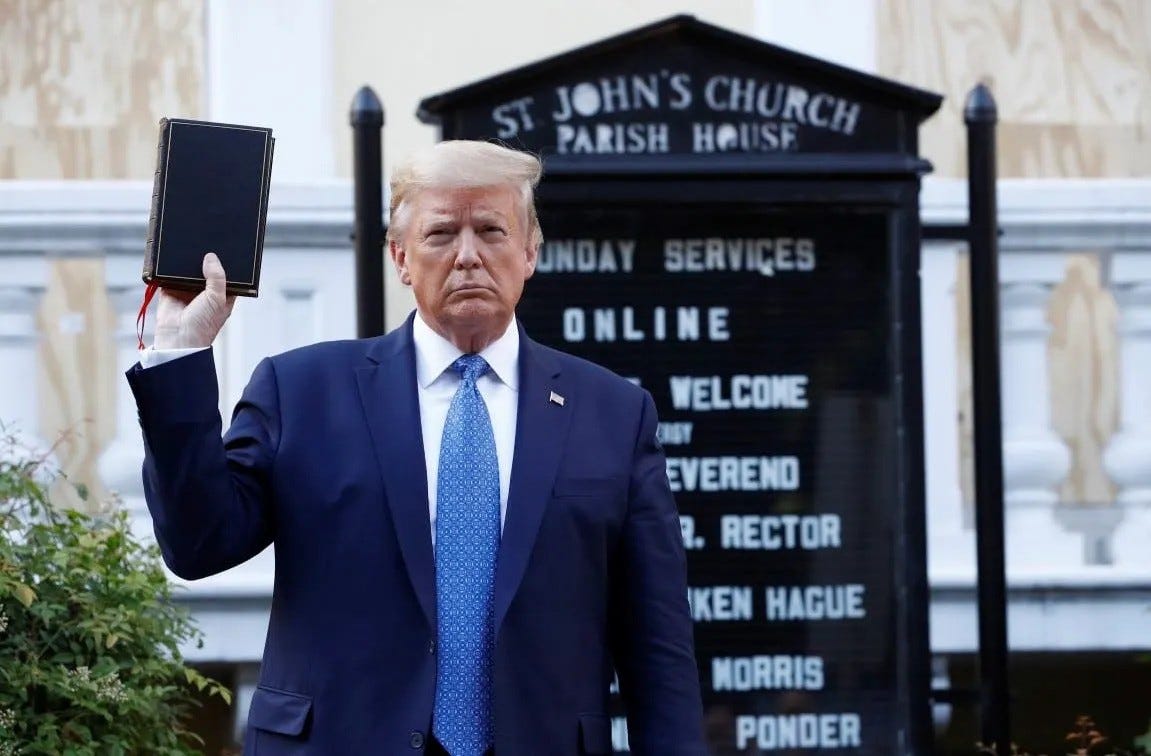
If Trump is deemed sufficiently Christian for a religious test for office, it would be just because he says he is. In that case, the concerns of many of those who pushed for ratification of the Constitution are proved correct. If someone can just say they’re a Protestant without ever actually practicing the faith, then dishonest people who are willing to say whatever just to get elected will always be able to pass the test. Honorable Catholics, Jews, Muslims, nonbelievers, and others would be ruled ineligible while godless liars would be approved for the ballot.
Additionally, if there were such a test, someone would have to adjudicate it. Secretaries of state would be asked to render judgment on the faith of would-be candidates, with judges also likely asked to weigh in when politicians disagree with the decision. This would create opportunities for partisan antics and would give government officials and the courts the supposed authority to define who is a Christian or not.
Given the rhetoric we heard from many Republican politicians falsely claiming politicians like Barack Obama or Kamala Harris weren’t Christians — even though both were actually more faithfully participating in church life than Trump — it’s not hard to imagine a secretary of state claiming a Democratic politician isn’t qualified because they’re not a real Christian. We’re even hearing that rhetoric this year in attacks on Democratic candidates who are actual Christian pastors or seminarians!
Or imagine if a Democratic secretary of state claimed Trump didn’t pass the test and so wanted to keep him off the state ballot, like we saw with a couple of efforts in 2024 over the Constitution’s insurrection clause. In the standard the rightwing majority of the Supreme Court created in that case, we would have to wait and see if Trump won and then Congress would decide if he passed the test or not before certifying the election. But it would be a real loss to the Christian witness (and the nation) to have a partisan debate in Congress as lawmakers voted to officially rule if Trump is a Christian or not.
Fortunately, the framers of the Constitution tried something different, creating a separation of church and state that is good for both. So we should give a failing grade to anyone who wants to undo this system and recreate what Isaac Backus called “the greatest engine of tyranny in the world.”
As a public witness,
Brian Kaylor