


On Saturday (May 16), my son’s middle school orchestra played at Busch Stadium ahead of a St. Louis Cardinals game. I enjoyed listening to them as a crowd grew to hear performances of songs like “Take Me Out to the Ballgame” and “Seven Nation Army.” My son particularly loved the latter since the cellos get to play the classic riff that forms the beat.
In addition to the experience of playing at the stadium, the orchestra students also got cheaper game tickets and could sell them as a fundraiser for the program. So after the pre-game concert, we found our seats to watch the Cardinals game.
It’s at this point I should mention that Saturday saw the Cardinals hosting Missouri’s other team, the Kansas City Royals. And I am a lifelong Royals fan. If the Cardinals had been playing anyone else, I would’ve been happy to wear a red shirt. But not when they’re playing the Royals. Even better, I have a shirt that says “Kratz 19” on the back, which is from when my friend Erik Kratz played for them back in 2014 and 2015 (when the Royals went to the World Series both years and won in 2015 — I have to point that out!).
That morning before we left, my son saw my Royals shirt and incredulously asked, “Are you really going to wear that?” His teacher had clearly gotten them all pumped up for the Cardinals and he even wore a Cardinals cap (teenage rebellion is a problem). But the real feeling of disconnect came later.
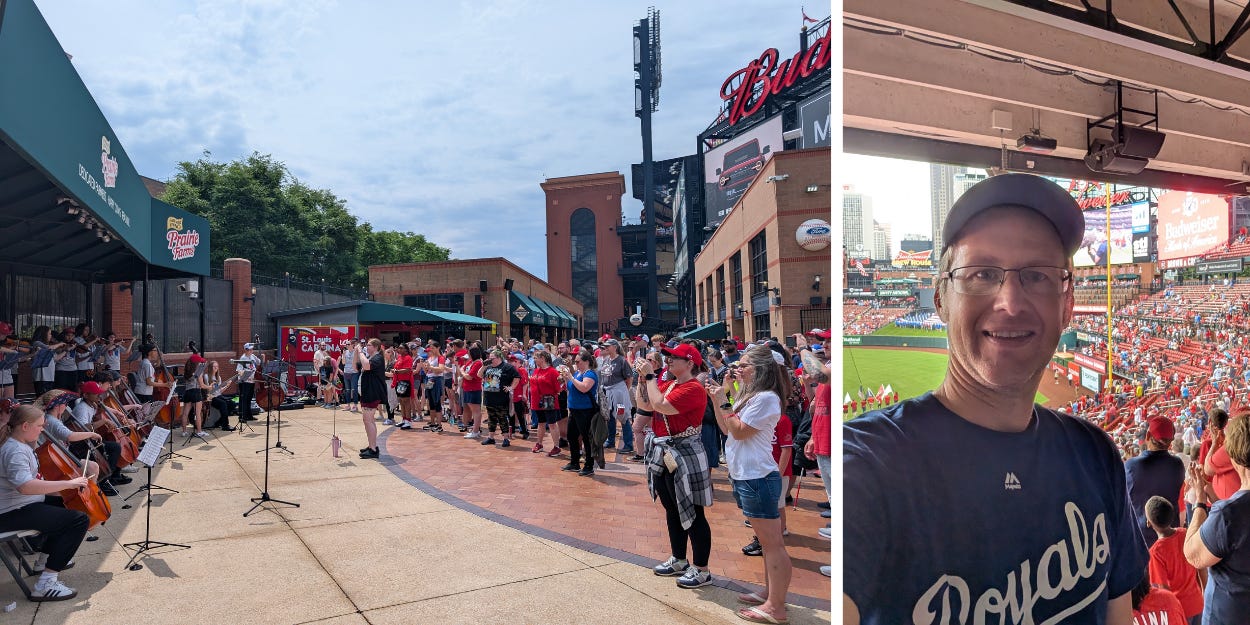
I’ve been to Royals games at Kauffman Stadium in Kansas City. And I’ve been to Cardinals games at Busch before when they played other teams, and I cheered for the Redbirds. I’ve also been to Wrigley Field when the Cubs played someone I didn’t care about, so I just decided to root, root, root for the home team. But Saturday was the first time I’ve gone into enemy territory to cheer for a team. Since it’s the next closest stadium to Kauffman, there were a good number of Royals fans. But our blue dots were, of course, still dramatically swamped by the red sea of Cardinals fans. Even where I sat, among other orchestra families, I stood out. Although Jefferson City is halfway between the two teams, the city has always been more of a Cardinals town. So I had to endure some ribbing from friends I sat with as their Cardinals beat my poor Royals (though the Royals came back to win the next day).
Standing in line to enter, I was conscious that I was a minority voice. My eyes also noticed every Royals fan as I passed them in the stadium. I almost felt like we should nod our heads to encourage each other to stand strong. But it was during the game itself that the experience diverged most significantly from previous games I’ve attended. When the Cardinals had a good play, the stadium erupted in cheers and applause. It was weird not joining in. When the Royals had a good play, it was almost like the crowd wasn’t even watching.
The next day, officials in the Trump administration and various rightwing preachers gathered on the National Mall in Washington, D.C., for their “Rededicate 250” rally that mixed worship songs and Bible readings with made-up Christian Nationalist history, a glorification of the United States, praise for President Donald Trump, and even claiming divine support for Trump’s desire to build a massive ballroom (and that’s what it means to take the Lord’s name in vain). Throughout it all, the crowd there cheered and applauded.
I didn’t attend in person, though I’ve been at plenty of such MAGA Christian Nationalist gatherings before. But as I listened to the event’s livestream, it at first felt a bit like being a Royals fan in Busch Stadium. Then I remembered there’s a big difference. While they put on a show and had powerful people send in video comments, they’re not actually the majority. As new polling shows, most people in this country are not rooting for the red hats or the Christian Nationalist team. The “Rededicate 250” organizers and speakers want us to feel like we’re in the minority so we’ll give up.
Redividing America
Sunday’s “Rededicate 250” was largely what I expected. Except for the fact that Trump did nothing for it. He was supposed to send video greetings, but they instead played a video he recorded for an earlier event. Not only could Trump, who hasn’t attended a Sunday worship service in 4.5 years, not be bothered to even show up for his “worship” rally, he didn’t even record a new video for it! The preachers and politicians sang his praises about how godly he was for announcing this event, and he made them out to be liars as he instead went golfing.
The rest of the day included familiar messages, although it was a lot less exciting than a ballgame with less interesting music between plays and a lot more (and longer) breaks for pitching changes. There were references to a May 17, 1776, event that was significantly different from Sunday’s gathering. There were mentions of fake history, like the false story about George Washington praying in the snow at Valley Forge that was depicted on the stage and mentioned by speakers like Pete Hegseth.
There were numerous recitations of Bible verses that Christian Nationalists like to use to justify their efforts. The most used Sunday was Psalm 33:12 about “blessed is the nation whose God is the Lord,” even though that passage is about Israel as “the people he chose for his inheritance.” Rev. Jonathan Falwell, who for some reason was invited instead of his brother, invoked Matthew 5:14 to call the United States the “city on the hill,” even though Jesus was actually talking about his followers and not a nation. And organizers played a video of Trump reading 2 Chronicles 7:14, which was actually just a rebroadcast of the video he recorded for last month’s “America Reads the Bible” effort.
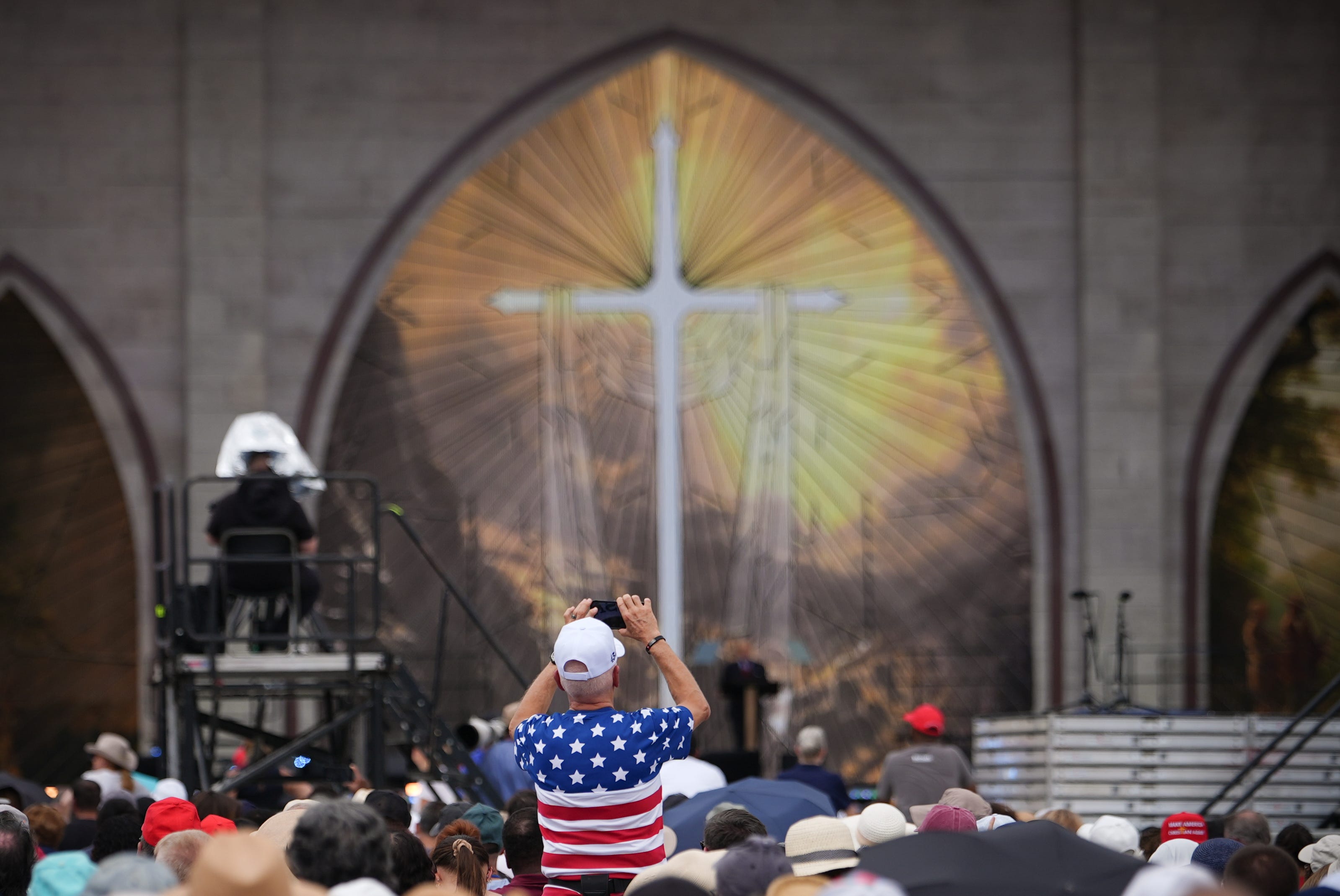
There were attempts to suggest the event was unifying despite the dearth of religious or political diversity. Perhaps most comically, Sen. Tim Scott of South Carolina tried to frame it as part of the nation’s “Judeo-Christian” heritage after starting his speech by repeatedly shouting, “How many of you love Jesus?!” And then he ended by shouting “Jesus!” several more times. Throughout, the rally was sectarian and partisan. All while the government used taxpayer resources to promote this quasi-official event that lacked bipartisan oversight or pluralistic input.
Anti-abortion activist Alveda King used her remarks to sing “This Little Light of Mine,” which she likes to do at government worship services. Franklin Graham bemoaned sin in American culture, complaining about those who are “lovers of self, lovers of money, proud, arrogant, abusive” (hmm, if only he could think of someone that sounds like). Lou Engle got down on his knees to, again, turn the country around with a dramatic prayer. Several speakers invoked the Christian faith of abolitionists and civil rights leaders, all while also supporting efforts to gerrymander congressional districts in order to undo the gains of the civil rights movement and chip away at Black representation.
Sprinkled between the divisive partisanship, fake history, and unconstitutional sectarianism from government leaders, Christian musicians and choirs did their best to worshipwash it all and to try and keep the crowd from leaving. And the crowd cheered and applauded for it all. Watching it, I almost felt like a Royals fan in Busch Stadium. But then I remembered a few thousand people don’t represent American democracy, and the National Mall on Sunday wasn’t the whole ballgame.
Survey Says…
These days, it can often feel like Christian Nationalism is the majority opinion. The crowd is cheering as they make big plays. But while Christian Nationalists have grabbed significant positions of power, many times it’s just that they’re being extra loud. New survey data from the Pew Research Center shows that those of us who oppose Christian Nationalism far outnumber its advocates.
For the first time since Pew started asking about it, most Americans say they have heard of Christian Nationalism. But as more people are learning about the concept and seeing it in action, more don’t like it. In fact, three times as many Americans say they have a negative view of Christian Nationalism than those who support it. (Most Americans still aren’t sure what to think, which is why we need to continue to warn about how it endangers democracy and the Christian witness).
Relatedly, most Americans still support church-state separation. Several speakers on Sunday attacked this constitutional concept because they correctly recognize that church-state separation is the antidote to Christian Nationalism. If we maintain such separation, then the Christian Nationalists can’t accomplish what they want to. But despite their attacks on this idea, the separation of church and state is the real American heritage worth celebrating and rededicating ourselves to. And most Americans agree, with 54% saying the “government should enforce separation of church/state” and only 13% disagreeing. Additionally, 81% say the federal government “should not declare Christianity the official religion of the U.S.,” while only 17% want that. And a majority of Americans (52%) say that “conservative Christians have gone too far in trying to push their religious values in the government and public schools.”
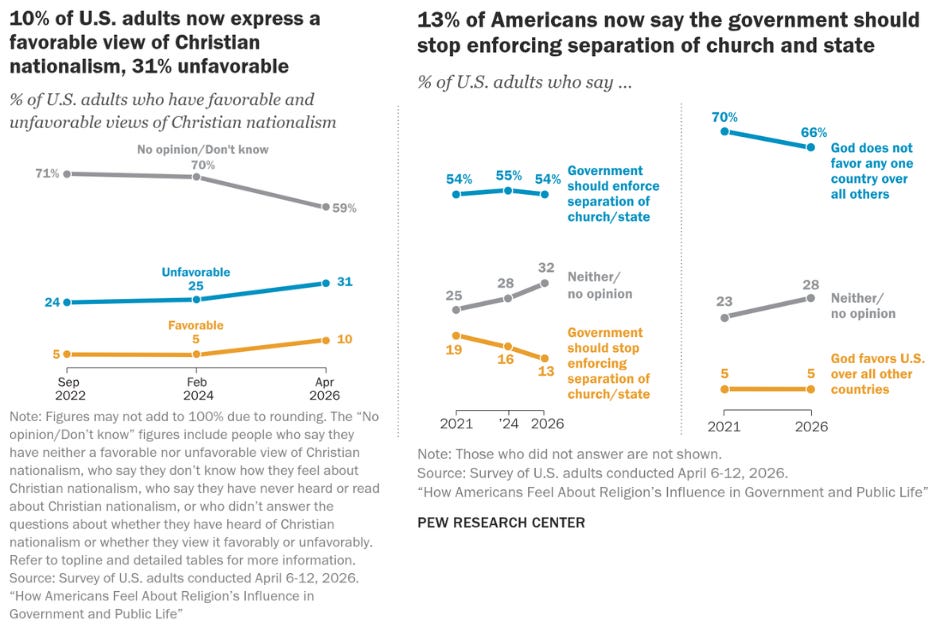
Even when looking at partisan and religious breakdowns, Pew found majority support. That is, the winning opinions among both Democrats and Republicans are that the government should continue to enforce church-state separation and we should not declare Christianity the nation’s official religion. The same thing is true for all religious groups, even White evangelicals.
Simply put, what we saw on Sunday was not only a misrepresentation of American history and principles (and Christianity) but also a misrepresentation of the American people today. While we must push back, we cannot allow their misdirection to lead us to give up. Because unlike the Royals this season, we can win.
As a public witness,
Brian Kaylor
As an agnostic, I’m appalled.
As a Christian I'm appalled.