


This summer, the United States celebrates its 250th birthday. To mark that occasion, thousands of Christians recently gathered on the National Mall to “rededicate” their version of America to their narrow and partisan conception of God. The factually inaccurate — but politically convenient — myth that the nation was founded to serve Christian purposes was both the premise of the event and the message it communicated.
Instead of distorting history for ideological ends, a better way for Christians to honor the Semiquincentennial is to rededicate themselves to learning the more complicated story of Christianity’s role in American public life. Matthew Sutton’s expansive new book, Chosen Land: How Christianity Made America and Americans Remade Christianity, is the perfect resource for understanding what the United States has been, not what some people wish it would be.
The book tells the stories of how so many different versions of Christianity have influenced the self-understanding of the United States. Some of them have enjoyed cultural dominance, reimagining the country in their own image. Others have been minority voices of dissent or marginal groups whose religious visions never took hold. All of them saw opportunity in the free market of religious expression to attract others to their religious mission.
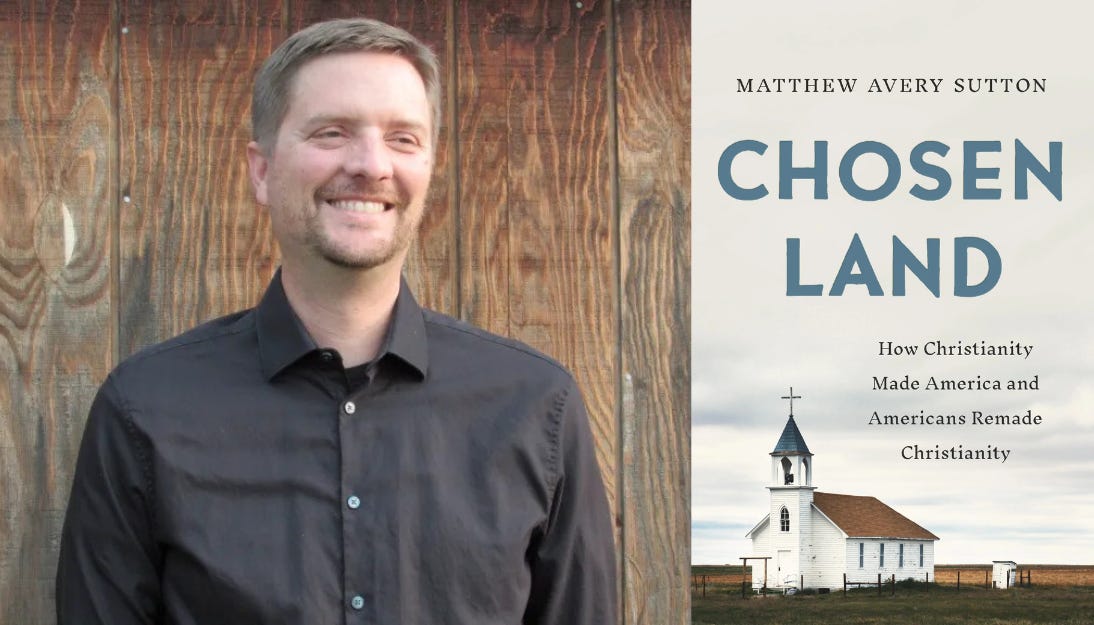
Sutton argues that Christianity is an underappreciated force for understanding U.S. history. While many narratives focus on economics, race, and politics as sources of cultural change, religious values and agendas can hold their own in explaining what links the past to the present. The title Chosen Land reflects both the sacred character many have ascribed to their activities and the peculiar nature of a democratic society that provided the liberty to pursue them.
Specifically, his argument “links Christianity to key facets of national development, suggesting that to understand American distinctiveness fully, we must account for how Christianity shaped and was shaped by every major historical development from education to war. Americans’ success at weaving Christianity into all aspects of their culture is what made the United States so unique.”
While Sutton argues that Christianity is integral to grasping what America has become, he is also clear that the Christian tradition within the United States is itself a contested identity. Throughout the book, he tracks four different “streams” that intermingle and disperse to shape the contours of the country’s life:
Conservatives “emphasized tradition, historic creeds, and the importance and centrality of the church and the church community.” This is not a political descriptor but a theological one. Conservatives “knew the world was a fallen place and hoped that their example would attract others to Christianity.”
Revivalists prioritized the individual. In doing so, “they made Christianity a commodity, a choice, something that one could purchase or return like a pair of shoes based on the whims of the day. They shifted the act of conversion from being the means of entry for non-Christians into an end unto itself — a sacrament required of everyone to authenticate one’s faith.”
Liberals privileged rationality, embracing the findings of science and expecting Christianity to evolve in response. They have also been the most open to ecumenical and interfaith connections and collaborations.
Liberationists drew on the ideals of their faith to “free people from stifling gender norms, economic inequalities, and racism.”
Chosen Land describes how these four different strands of Christianity encountered and competed against each other to legitimize their causes, determine the direction of society, and define what it meant to be a Christian in the United States. It’s a plot that continues to unfold today.
Despite the lengthy nature of the volume and the breadth of events it covers, Sutton writes in a way that is both engaging and accessible to any curious reader. His work is likely to define how a generation of Americans perceives the ways church, state, and culture have intersected.
Religious studies scholar Anthea Butler writes, “Chosen Land is an insightful, compelling, and deftly written new interpretation of the history of Christianity in America. Sutton’s redefinition of America as a Holy Land is a powerful tool to understand America’s history, and its future.” That endorsement makes clear that this book warrants your attention, especially when so many other stories will be told this summer about the place of faith in our public life as America looks back on the last 250 years in partial, parochial, and partisan ways.
Matthew Sutton has graciously agreed to autograph his book for one lucky paid subscriber of A Public Witness. Upgrade your subscription today and you’ll receive ALL of our reporting, analysis, and commentary about the ways Christianity intersects with politics and culture. Plus, you might be the chosen one who receives a signed copy of Chosen Land in your mailbox.
As a public witness,
Beau Underwood
18 U.S. Code 1513 makes it a Felony to seek to relatiate 0r seek revenge against any person for action they have taken in any investigation or trial involving any action taken related to a federal crime. The action against Mr. Comie seems clearly to violate this statute.