



Last month, a new book came out from Steven Rosenbaum warning about how AI is impacting our brains and our conception of truth. But The New York Times uncovered an ironic problem with The Future of Truth: How AI Reshapes Reality shortly after it was published: it includes several misattributed or made-up quotes that were created by AI!
Rosenbaum has tried to spin the problem as proof that his book is right: “These AI errors do not, in fact, diminish the larger questions that the book raises about truth, trust, and AI and its impact on society, democracy, and editorial.” That’s pretty weak, but his answers to Wired were even worse as he said he would rather just stop writing than stop using AI in his writing. In that case, we say he should, in fact, just stop writing.
We promise we do not use AI to write, create citations, or edit our work. And there are many other authors who similarly are actually writing. We enjoy discovering a good book that came from the mind of a human and not from an AI bot that stole and repackaged the work of others.
So as we publish our fifth annual list of recommended books for summer reading, we want to assure you we are real people suggesting real books that you can actually buy or grab from your local library. We’ve once again asked several Word&Way writers to offer two books perfect for wherever you find your real happy place this summer.

Some Recommended Books
Brian Kaylor, author of The Bible According to Christian Nationalists:
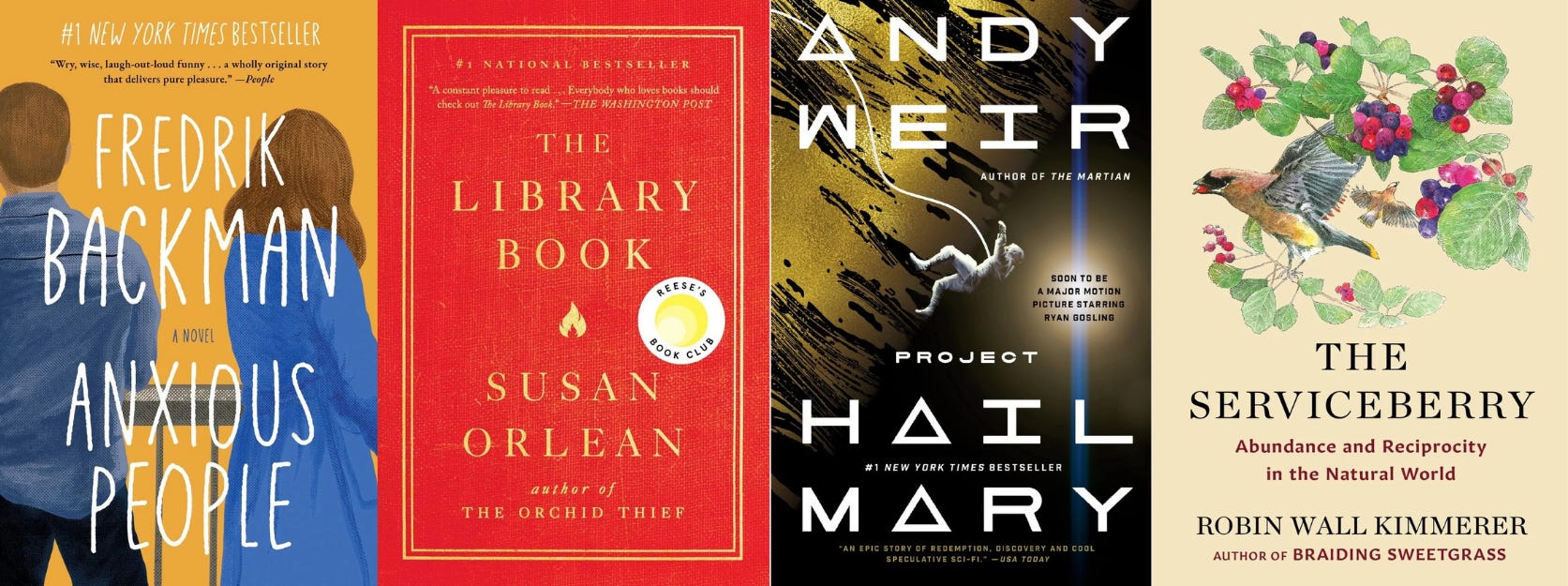
Anxious People by Fredrik Backman. From the author of A Man Called Ove (a fantastic novel that was adapted into the movie A Man Called Otto starring Tom Hanks), this book is also wonderful with humor, plot twists, and a puzzle to slowly put together. After a thief fails to rob a bank since it’s cashless, they end up accidentally taking people hostage across the street in an apartment that’s having an open house. From there, Backman unwinds a quirky tale that captures unexpected interconnectedness between different people. All while some detectives — and the readers — try to figure out who the robber is. There’s a Swedish-language miniseries adaptation of it on Netflix (since the novel was originally written in Swedish), and there’s an English-language movie in the works with Angelina Jolie, Aimee Lou Wood, and Jason Segel.
The Library Book by Susan Orlean. This book is really three books masterfully woven together. It tells the story of the 1986 fire at the Los Angeles Central Library, the largest library fire in the United States. It’s still a bit of an unresolved mystery, which Orlean unpacks to complicate the narrative about the arson that destroyed or damaged more than one million books in the library that opened a century ago this year. With that tale, the longtime staff writer at The New Yorker weaves in her own personal experiences in libraries and their broader history. It’s a delightful and insightful read, especially for anyone who loves books.
Sarah Blackwell, author of God is Here:
Project Hail Mary by Andy Weir. It may not be much of a stretch to write a book recommendation on a popular novel that forms the basis of a new major motion picture, but I tend not to read science fiction and probably would have skipped this book if it were not by the author of The Martian, the last sci-fi book I read and enjoyed. Yes, Project Hail Mary is a futuristic, action-filled page-turner about saving the world; however, what makes the book worth reading is the unlikely friendship at the core of the story. While exploring the universe, it also delves into what it means to love your neighbor in the most extreme of circumstances and what it might look like to lay down one’s life for others. Since I teach college students, I am always looking for popular media that can engage them in the deeper questions of life — and this novel hits the right chord.
The Serviceberry: Abundance and Reciprocity in the Natural World by Robin Wall Kimmerer (illustrated by John Burgoyne). If lazy days of piddling around in the summer are more your speed, this short volume by the author of Braiding Sweetgrass may be the perfect complement to a quiet evening in a rocking chair with a cold glass of lemonade. Sometimes a book comes along that is a balm to the burns and scars of the world — The Serviceberry has these types of healing properties for our communities that are taxed by dissention and natural lands that are marred by overuse. It does so by focusing on sustainability over consumerism. One would not think a book about a wild berry would be so captivating, but the observations within recalled simpler days of picking the first berries of summer and sharing fresh-made cobblers with friends and family. The central tenet is the idea of reciprocity, that shared benevolence and contributing the gifts we already have (whether physical, mental, or emotional) can make our communities better.
Jeremy Fuzy
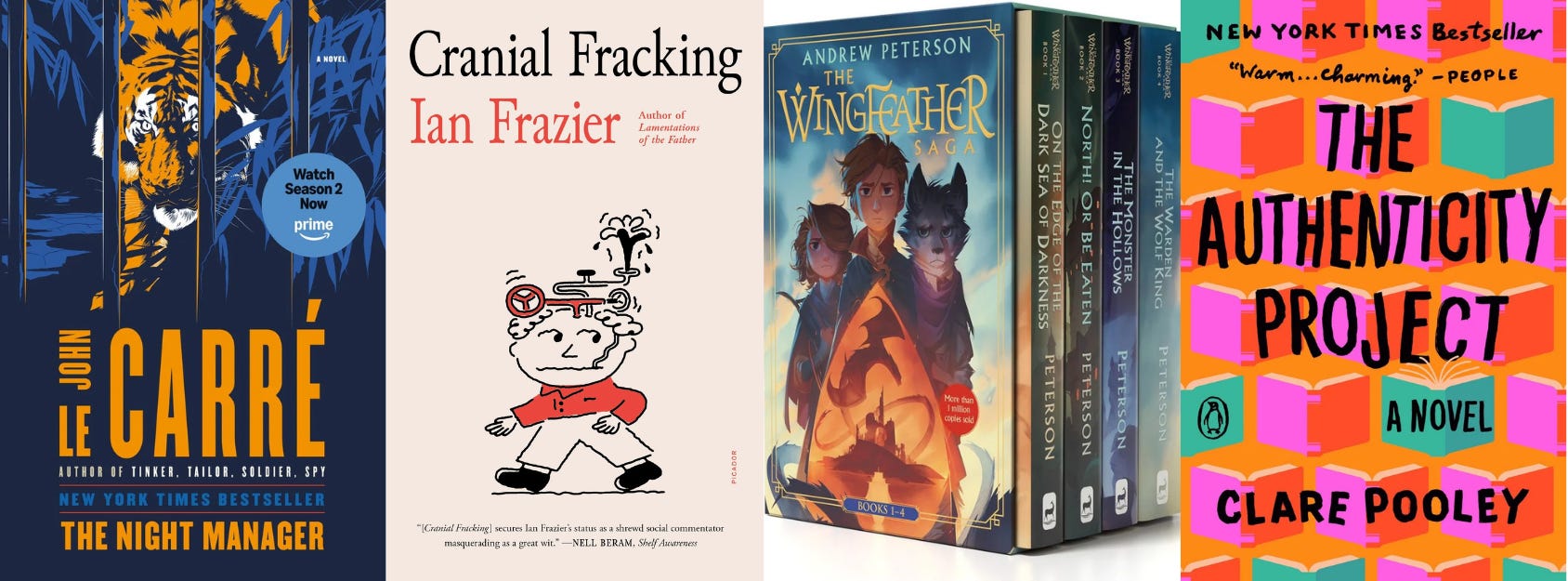
The Night Manager by John le Carré. I was inspired to pick up this 1993 novel after watching the recent second season of the excellent BBC series by the same name, starring Tom Hiddleston and Hugh Laurie, that adapted (and added to) the source material. This is a smart and propulsive espionage novel set in the aftermath of the Cold War, where unconstrained global capitalism has created a cabal of greedy criminals who are not bound by ideology or law. Traditional intelligence agencies are failing to meet the challenge as institutions, and the only option is for our protagonist, Jonathan Pine, to go undercover as an everyday service worker who can remain virtually invisible to the wealthy arms dealers as he gathers information and infiltrates their networks. It truly contains everything you could want from a spy thriller and then some.
Cranial Fracking by Ian Frazier. One of my favorite things to read while traveling and relaxing in the summer is a collection of short stories. You can easily start and finish an entire mini-narrative between dips in the water or during a layover — and this book perfectly fits that bill. Written by a longtime staff writer for The New Yorker, each chapter contains a different insightful take on the perplexing world we live in. With deadpan midwestern wit, Frazier walks the line between social commentary and absurdist humor. If the notion of exploring the impact of climate change on Hades, advocating for mummies in the golden age of zombies by invoking Jane Austen, or a former scoutmaster detailing the obscure heresies he collected that led to his ouster (think Bogomilism, Pelagianism, or Albigensianism) brings up a chuckle, this one’s for you.
Juliet Vedral
The Wingfeather Saga by Andrew Peterson. Fans of C.S. Lewis, J.R.R. Tolkien, and even J.K. Rowling will appreciate these four fantasy novels, centered on the three Igiby children, Janner, Kalmar (Tink), and Leeli, and rich in Christian themes. Set in a world that has largely been occupied by Gnag the Nameless, an evil overlord bent on remaking humans in his own image, the children must find their way to safety and defeat Gnag’s armies of Fangs (Lizard, Wolf, and Bat People) while reclaiming their destiny. The first two books are a little slow, but the last two are hard to put down. I started reading these with my sons at the same time my friends started reading them with their kids, and they are as compelling for kids as they are for adults.
The Authenticity Project by Clare Pooley. Looking for a thoughtful and uplifting story that can double as a poolside read? Then this book is very much for you. The story is set in London and centers on six different people who are brought together by a mysterious green journal containing one man’s honest confession about his life. It’s a fun and heartwarming story that is easy to digest and will leave you feeling hopeful about life — something we all kind of need right now.
Beau Underwood, coauthor of Baptizing America:
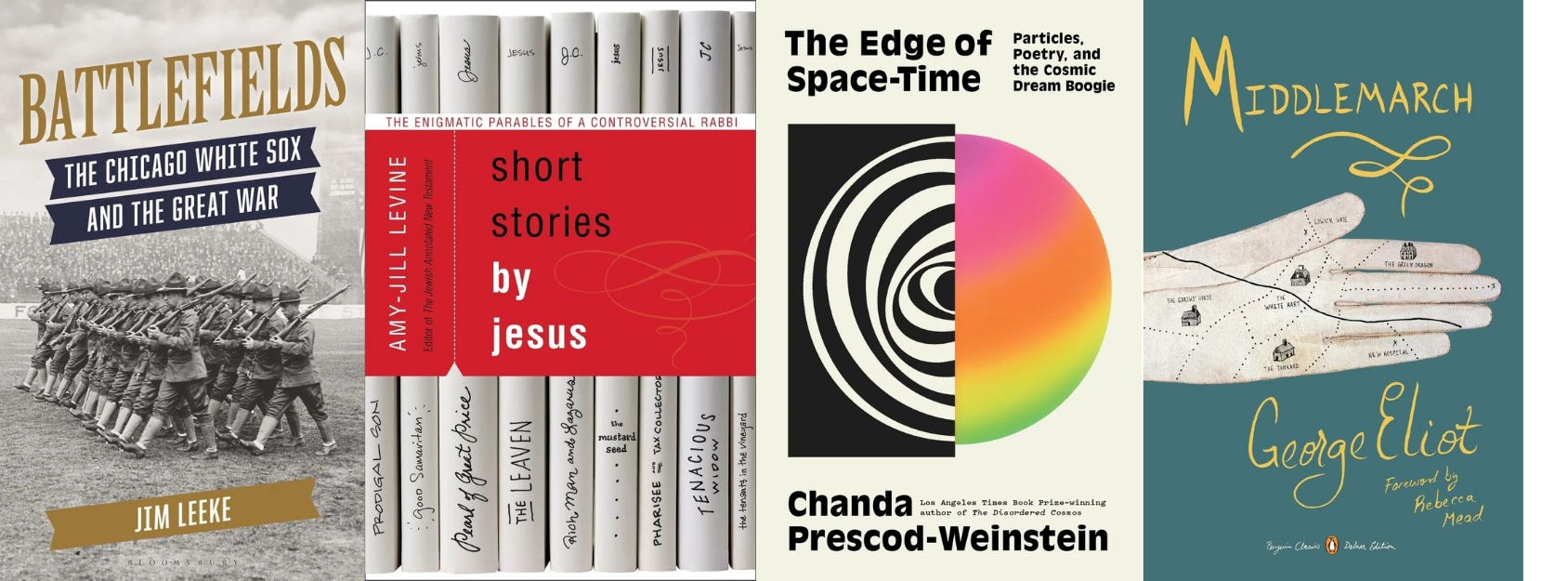
Battlefields: The Chicago White Sox and the Great War by Jim Leeke. In my household, we’ve dubbed this the “summer of baseball.” There are trips planned to more than a dozen MLB games in a half dozen cities, passionately following the surprising success of my beloved Chicago White Sox, and playing as much baseball with my son as possible. It all serves as a valuable distraction from the chaotic and perilous times we’re living through. Battlefields explores how the White Sox navigated through another challenging period: the years in which the U.S. fought in World War I. It describes how that conflict changed the game of baseball alongside so many other aspects of our national life.
Short Stories by Jesus: The Enigmatic Parables of a Controversial Rabbi by Amy-Jill Levine. While not a new title, this book is the perfect resource for my planned summer Bible study on the parables of Jesus. The volume is accessible for a layperson, but packed with the insights of a leading New Testament academic whose perspective is that of a Jewish scholar studying Christian constructions of Jesus. Levine conveys both how radical the parables are in their implications and how common they were in the examples they draw upon. At a time when many conflate American culture with the teachings of Christ, this book reminds us how provocative, challenging, and life-giving Jesus’s demands can be, if only we will listen to them with ears to hear.
Sarah Miller
The Edge of Space-Time: Particles, Poetry, and the Cosmic Dream Boogie by Chanda Prescod-Weinstein. If you’re someone who takes the occasional trip down a Wikipedia rabbit hole in a futile attempt to understand the nature of the universe, consider making theoretical physicist Prescod-Weinstein your next tour guide. As the title suggests, her passionate and poetic explanations of gravity, quantum particles, light, and more are intended not to help you master the material, but to see the world with new eyes as you journey to the edge of what humans currently know about physical reality. Along the way, she illuminates the political, ethical, and cultural dimensions of physics and makes a passionate case for scientific exploration as essential to human flourishing. At the end of the journey, I found myself appreciating physics’ open questions as much as its answers, and amazed at the human ingenuity it takes to know anything at all about our mysterious universe.
Middlemarch by George Eliot. Eliot’s masterpiece has no shortage of advocates — it recently topped The Guardian’s 100 Best Novels list — so I doubt I can tread any new ground here, but I can attest that it makes a great, sprawling summer read. Set in a rural community facing the technological and political changes of 1830s England (the railroad and the first Reform Act, respectively), the novel is an honest and empathetic exploration of human agency. As idealist Dorothea Brooke and medical reformer Tertius Lydgate struggle to do some measure of good in the world, they contend with the inertia of social mores and the all-too-human flaws in their own judgment. Their progress, while never unchecked, is a testament to the small acts of magnanimity, imagination, and grace that sustain our shared life.
John Sianghio
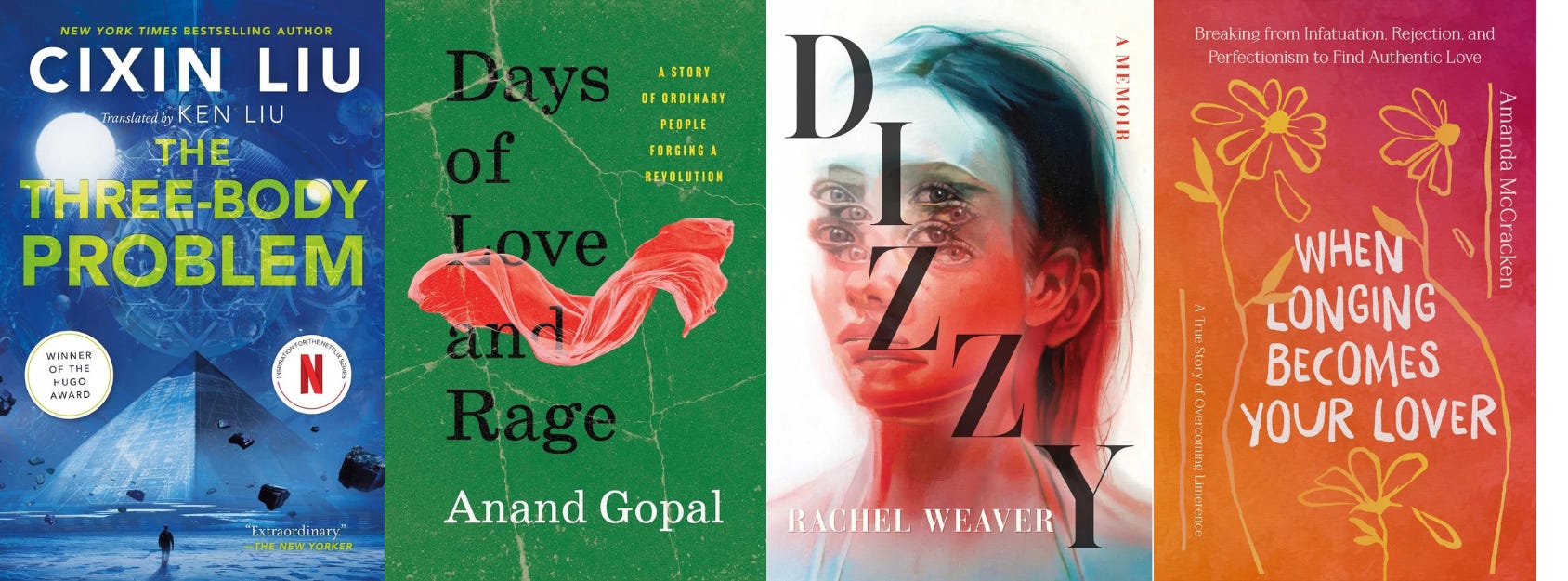
The Three-Body Problem by Cixin Liu (translated by Ken Liu). In her masterwork The Human Condition, Hannah Arendt wrote that science fiction deserved attention “as a vehicle of mass sentiments and mass desires.” The Three-Body Problem is an exemplar of Arendt’s observation. A contemporary story with the Chinese Cultural Revolution as its critical backdrop, the book is a rare opportunity to explore the sentiments, desires, values, and visions of a non-Western culture through the vehicle of a high-flying space odyssey grounded in a gritty neo-noir mystery. Real-world technological advances like AI, once firmly in the realm of science fiction, continue to drive reexamination of our relationship to science, faith, and God. This novel explores all of these themes without sacrificing an iota of its gripping storytelling — with perhaps its most profound insight being that the most important thing for understanding these relationships is our relationship to one another.
Days of Love and Rage: A Story of Ordinary People Forging a Revolution by Anand Gopal. This book narrates events within one of the great geopolitical crises of the 21st century while delving into themes of economic, social, and political theory through its narration of the city of Manbij’s short-lived experiment in revolutionary democratic self-government amid the Syrian Civil War. Yet the book reads neither like the report of a war correspondent nor a treatise on government. Rather, from its opening vignette, Gopal immerses readers in the sights, sounds, and stories of the city and its citizens in a way that brings Manbij alive as vividly as James Joyce’s Dublin, Charles Dickens’s London, or Victor Hugo’s Paris. Defying its status as nonfiction, the story focuses on the private passions and personal disillusionments that fuel the love and rage of its title in epic fashion, more reminiscent of the Iliad and Odyssey than the AP wire.
Kristel Clayville
Dizzy: A Memoir by Rachel Weaver. In January 2006, days before starting a Master of Fine Arts program, Weaver woke to a world that wouldn’t stop spinning. Dizzy traces the eighteen years and more than forty clinicians it took to name and finally quiet her illness, including a long passage through dismissal, misdiagnosis, and the particular loneliness of a body no one can explain. Set against her earlier life studying wildlife in the Alaskan wilderness, she writes about suffering without flinching and about hope without sentimentality. For readers drawn to questions of endurance, meaning, and how we keep faith inside deep uncertainty, this is a luminous and unsettling companion.
When Longing Becomes Your Lover: Breaking from Infatuation, Rejection, and Perfectionism to Find Authentic Love by Amanda McCracken. By her late thirties, McCracken had dated more than a hundred men when a therapist finally named what had shaped her: limerence, an addiction to longing itself. In this candid and often funny memoir, she traces that craving back to the evangelical purity culture of her girlhood, where adolescent desire was redirected into waiting for the husband God supposedly had in store. Weaving research with confession, she argues that purity culture and hookup culture can both leave a person attached to wanting rather than to loving. Readers wrestling with faith, formation, and desire will find an honest, generous map toward something more real.
Read On
With the variety of books we’ve compiled, we hope you’ll find a couple worth adding to your summer reading plans. And if you need more options, you could always look back at our 2022, 2023, 2024, and 2025 lists.
There are plenty of great books out there, so you shouldn’t need to ask AI to slop one together for you!
As a public witness,
Brian Kaylor & Jeremy Fuzy
I appreciate these lists! Thank you for doing them -