


During a recent appearance on Fox News, Speaker Mike Johnson was asked to respond to a comment that he’s aiding a “Christian Nationalist crusade” to undermine the United States’ heritage of church-state separation. He responded with the tired claim of suggesting that those who oppose him are just godless (and thus apparently shouldn’t be listened to).
“The people who are the naysayers and who have created this new term of ‘Christian Nationalism’ as a pejorative, a derogatory term, are trying to silence the influence and the voices of Christians, and I think that’s wildly inappropriate,” he declared on the morning of the so-called “Rededicate 250” event that pushed Christian Nationalist myths about U.S. history.
Let’s put aside his absurd claim that the term “Christian Nationalism” is new (simply because he’s just learned about something doesn’t make it new). The even more inaccurate allegation is that those who critique Christian Nationalism just want to silence Christians. Johnson’s either lying or isn’t paying attention because many who challenge Christian Nationalism, like me, do so as Christians who remain deeply concerned about the integrity of the Christian witness.
So last weekend, I found myself on the campus of Villanova University in Pennsylvania for a conference as Catholic and Baptist scholars gathered to critique Christian Nationalism. And we did so from deeply Christian theological perspectives.
The annual convention of the College Theology Society (a group that primarily brings together theology and religious studies professors and graduate students from Catholic institutions of higher education) met in conjunction with the National Association of Baptist Professors of Religion. Gathering on the campus of Pope Leo XIV’s undergraduate alma mater — and the Vatican even sent greetings to the conference from Leo — the conference centered on the theme “Reclaiming Faith Amid Christian Nationalism.”
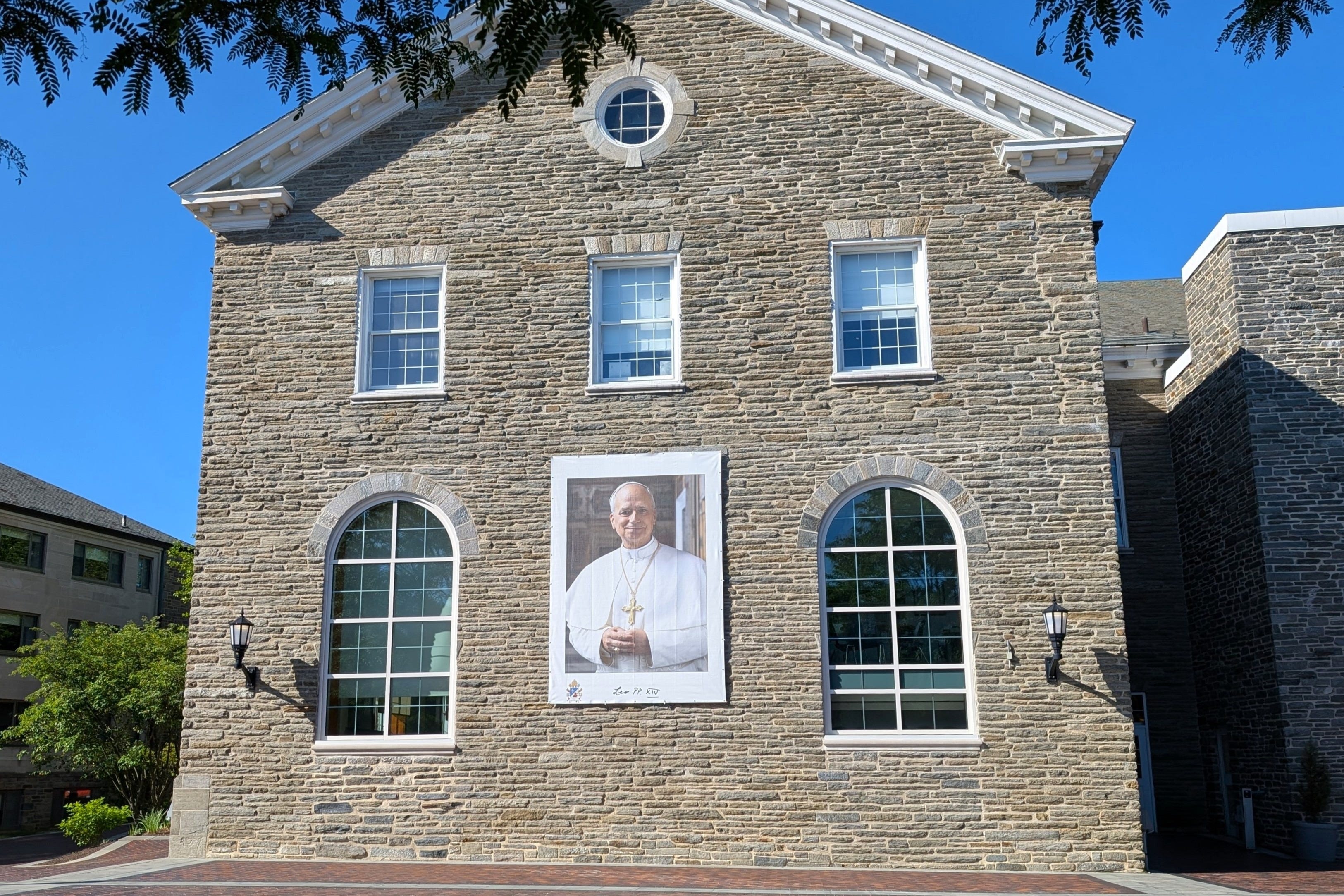
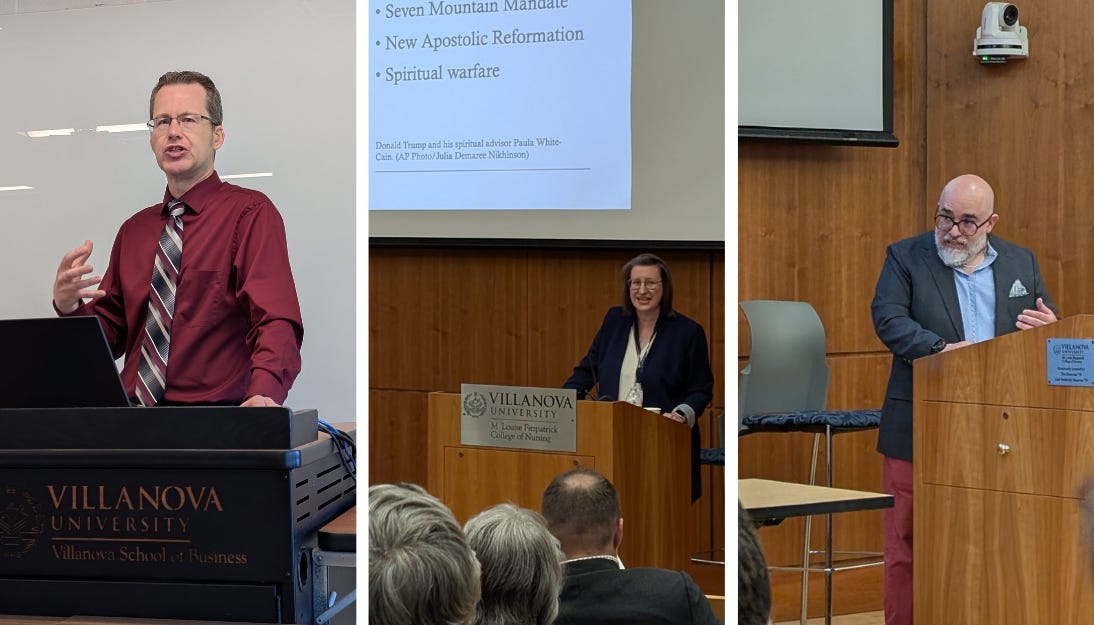
The conference mainly focused on the current threats of Christian Nationalism to the nation and the Church from evangelicals like Johnson, Pentecostals like Paula White-Cain, and Catholics like J.D. Vance. To complicate the narrative and broaden the perspective, I was invited to speak on how moderate and progressive mainline Protestants helped push Christian Nationalism (largely drawing from the work of Baptizing America).
Since Villanova’s campus sits just a few miles from Valley Forge and the image of George Washington praying on bended knee in the snow has been particularly popular lately with officials in the Trump administration, I mentioned how exciting it was to talk about Christian Nationalism so close to where that prayer moment did not occur. The myth of that story (and the religious bigotry against Quakers embedded in the original version) highlights the problems of Christian Nationalism then and now.
The weekend included numerous excellent presentations unpacking various aspects of Christian Nationalism, its theological errors, its civic threats, and how to resist. So this issue of A Public Witness takes you inside the conference to hear from scholars as they offered ways to push back against this dangerous ideology.
American Idol
Anna Scheid, a theology professor at Duquesne University, spoke about the prophetic witness of the World Alliance of Reformed Churches in 1982 to declare South African Apartheid — which was supported and implemented by many White Reformed churches — a heresy. That effort was particularly spearheaded by Black South African theologian Allan Boesak, who Scheid leaned on for defining heresy as she applied it to Christian Nationalism today.
“To reunite the body of Christ, we must declare that Christian Nationalism is a heresy,” she said. “It’s not good news. It mocks God’s efforts to deliver the oppressed from bondage. And it disavows the redeeming and reconciling love born of faith in Jesus Christ.”
“Theologically speaking, Christian Nationalism is a violation of the first commandment: ‘I am the Lord your God. You shall have no other gods besides me,’” she added. “Christian Nationalism asks us to make the nation the source of our hope, and asks us to trust in idols for our safety and glory. … For the living God, Christian Nationalism substitutes a mediocre American idol.”
Drawing on the work of sociologist Andrew Whitehead, Scheid highlighted how Christian Nationalism promotes the idolatry of power, fear/grievance, and violence. She added that it’s also “a heresy because it divides us from one another” and “encourages hatred and exclusion.” As a key example, she pointed to a violent prayer offered by Pete Hegseth during a worship service at the Pentagon in March.
Alessandro Rovati, chair of the Theology Department at Belmont Abbey College, also contrasted the virtues taught in submitting to “the way of Jesus’s lordship” versus the values of idolatrous Christian Nationalism: “One rooted in weakness rather than power, self-emptying rather than dominion, love rather than strength.”
“[Christian Nationalism] is not one of the issues confronting Christians; it is the issue confronting Christians. The biblical weakness and the church’s teachings following it are unequivocal: Because of sin, we are often confronted with idolatry. We often place our hopes in things and people who do not lead us to authentic nourishing,” Rovati added. “The Church puts us in front of our many self-deceptions and reminds us about the truth about ourselves and the world. We are dust, in constant need of God’s mercy. The more we enter into such an awareness, the more we will experience the passage from that to life, from powerlessness to the possibilities of God, from allegiance to our many worldly idolatries to knowing and loving the one and truth.”
Brent Little, chair of the Catholic Studies Department at Sacred Heart University, emphasized how Christian Nationalism is both “idolatrous” and “collective narcissism.” He lamented that despite this, many American Christians “do not want to recognize how nationalism has perverted their faith,” instead wanting to believe “that Christianity and the nationalistic political agenda” are “completely compatible, so as to conveniently ignore any friction between the two loyalties.”
Similarly, José Francisco Morales Torres, a Christian Church (Disciples of Christ) minister and a professor of comparative theology and philosophy at Chicago Theological Seminary, criticized the “idolatrous force” of White Christian Nationalism. He argued that “one of the heretical strains that grounds White Christian Nationalism” is what he called “anthropological Docetism.” Referring to the ancient heresy that denied Jesus took on human form and only seemed human, Morales argued that this new form of Docetism that again removes Jesus from his body and that “privileges the invisible soul” over actual bodies.
“White Christian Nationalism, to possess a kind of Christian signature, decarnates the Word by rejecting the brown, fleshly Messiah and by rejecting a fully theological anthropology that makes demands on the body and not just our hearts or souls,” Morales explained. “Christian nationalism forges idols to seem Christian enough to ‘sanctify’ the hidden ways White supremacy is enfleshed in the world.”
Divorcing Jesus from his body, Morales added, not only lifts up Whiteness but also is used “to deny the full humanity of the racialized other and to ignore the incarnational faith that orients us to the weightier matters of the law — justice and mercy.”
Empire or Exile?
Janna Louie, an American Baptist Churches USA minister who serves as chief of staff for the Baptist Joint Committee for Religious Liberty, argued that merely critiquing rightwing expressions of Christian Nationalism misses the larger “reality that the U.S. empire is a project of settler colonialism that sustains itself through neoliberalism’s reliance upon free and cheap labor.” Such a focus also “seems to absolve the religious left from examining itself and their complicity to the neoliberal agenda of the U.S.” Thus, she added, “to resist propensities towards nationalism requires an acknowledgment of complicity with neoliberalism” and requires that we “contend with the U.S. empire’s continued reliance upon free and cheap labor.”
“Selling Bibles endorsed by the president is merely a symbol of the U.S. hubris as a source and promoter of global market capitalism,” she added.
Louie argued that in challenging Christian Nationalism, “sustainable resistance requires much more than symbolic opposition. It calls for an exilic witness grounded in the biblical theology of exile.” This includes contending with how Christianity has been used to justify the U.S. empire and colonial work.
“The story of God’s people through the Babylonian exile provides insight for sustained resistance and a perpetual invitation to confession in order to ground faithful witness,” she explained. “The people are not spared from the violence of empire-building. But there is a persistent reminder that being on the underside of the empire meant being closer to God. It’s when the people of God find themselves on the side of the empire or moving towards the side of empire-building power that judgment and justice call God’s people to account. In this, a biblical theology of exile invites God’s people to a practice disposition that rejects any form of empire-building power. To embrace exile as faithful and prophetic witness is to resist the use of power.”
“An embrace of exile is counterintuitive in a world that clamors for power and control. An assumption of exile frees the people of God to ask ‘how to be faithful’ rather than ‘how to win,’” she added. “To embrace exile is to commit to a disciplined practice that continually examines human propensities toward power and control.”
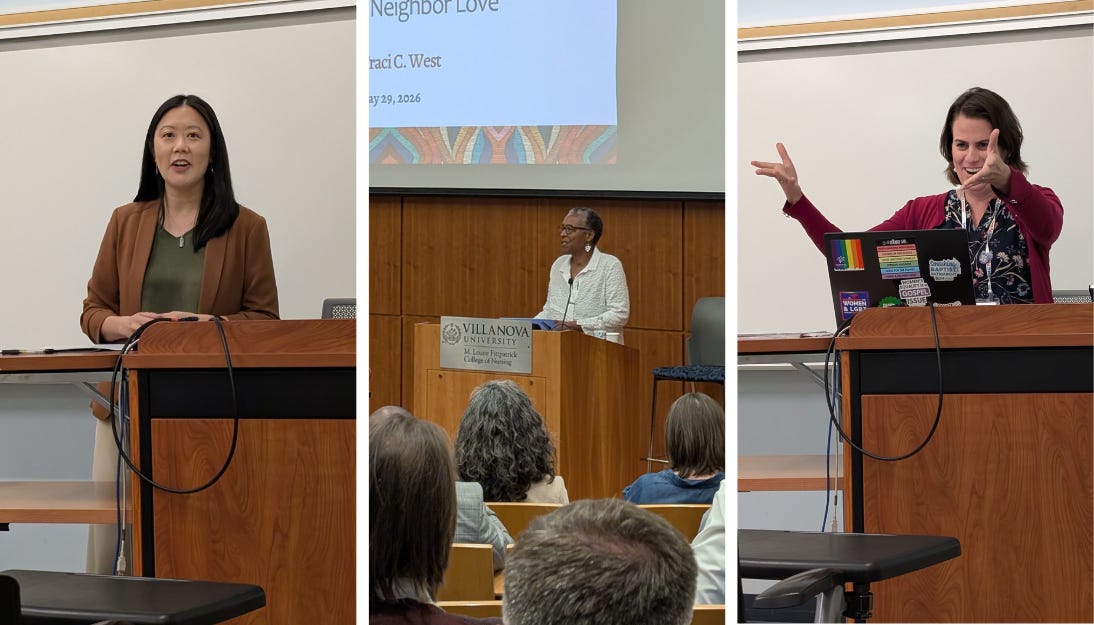
Kate Hanch, director of the Baptist House of Studies at the Perkins School of Theology at Southern Methodist University, similarly recounted how Southern Baptists and others used appeals to Scripture to justify slavery and the violence of such a capitalistic system. She traced how early approaches to what eventually became known as biblical “inerrancy” were employed to craft a justification for slavery, and therefore to dissent against slavery was “to attack the Bible itself.” She noted that the same method of interpretation is used today by Southern Baptists to argue against women in ministry and to attack those who support women. And she pointed to Doug Wilson, who she noted preached in February at the Pentagon, as a contemporary example of someone using the Bible to defend slavery and attack women in leadership.
“Today, these claims of objectivity are rooted in inerrancy and have been utilized by theologians and politicians alike to promote a Christian theocracy at the expense of marginalized people for the sake of the power and privilege of the few,” she argued.
It is precisely because of that past and present use of the Bible and Christianity to support empire and its oppressive economic systems that Louie urged dissent from not just Christian Nationalism but all forms of empire-building. And such exilic dissent, she added, means we must be honest about our own roles in the system.
“There’s no path forward unless we engage with the legacies of Manifest Destiny, which reinforce the reliance upon the violence of chattel slavery and the continued racial subjugation to actualize the expansion of the U.S. empire,” Louie said. “Perhaps the most Christian starting place is the acknowledgment that we all have blood on our hands. When we confess that there’s no one righteous, we can humbly find our place as faithful witnesses together.”
As a public witness,
Brian Kaylor